Showing posts sorted by relevance for query punch judy. Sort by date Show all posts
Wednesday, August 12, 2020
PUNCH Kamikaze!
Puppets Come Home! & Drama of Works present...
-- PUNCH Kamikaze: Punch & Judy --
When: Thursday, August 13th, 8pm ET
Where: www.coneyisland.com/puppets
Who: Adults Only
An assortment of puppeteers perform various scenes from the 358-year-old traditional English puppet show, Punch & Judy.
FEATURING:
- Drama of Works (Brooklyn, NY)
- Connor Hopkins, Artistic Director and Janitor, Trouble Puppet Theater Company Workshop (Austin, TX)
- Deborah Hunt, Jorge Díaz and musician Agustín Muñoz (San Juan, PR)
- Jeghetto's Entertainment, LLC (Asheville, NC)
- Sarah Nolen, Resident Artist at Puppet Showplace Theater (Boston, MA)
- Noisy Oyster (Somerset, UK)
- Brendan Schweda/Puppets Come Home! (Brooklyn, NY)
- Tooth and Nail Cabaret = Elle Love, Caitlin Ross and Marcus Fioravante (all over the place)
- Amy Trompetter/Redwing Blackbird Theater (Rosendale, NY)
* * * * * * * * * * *
Once upon a time in Coney Island, there were so many Punch & Judy shows happening, that "Punch and Judy together with [their cohorts] the devil, the priest and the hangman could be viewed on almost any part of the beach..." - Brooklyn Daily Eagle, 10 Jun 1878
For the first time in PUNCH puppet slam’s history (it’s been around in some form since 2005) we are taking on our namesake! Artists who already had a tradition of doing Punch & Judy shows were asked to share a snippet of their piece with us or create a new scene for this event - and it’s going to be EPIC!!!
“Kamikaze” is a term Drama of Works uses for its themed puppet slams, based around one story/event/play. A multitude of puppet artists are given sections of the story to reinterpret and create with wild abandon. Then it is presented in order. No one knows how it will come together until the night of the show. www.dramaofworks.com/punch
Puppets Come Home at Coney Island is a series designed to celebrate Coney Island's 150-year legacy of puppetry & provide a platform for contemporary cutting-edge puppeteers. Produced in collaboration with Coney Island USA.
Suggested Donation - A link will be provided during the show to support the artists, and a portion of the proceeds will go to the Domestic Violence Project at the Urban Justice Center.
PUNCH Kamikaze is made possible in part through the generosity of The Puppet Slam Network.
Monday, June 14, 2010
GSW9: Festival Report VII

Tess Elliot has this report from the final day of the Great Small Works 9th International Toy Theatre Festival in NYC:
We saw Laura Heit's miniature theater, called “Bureau of Small Requests: the 76 Departments of Tomorrow” and for the smallest show, they put the most people in the theater to see it. I think the reasoning is that she designs her shows to be displayed on video (though the color on the video was really bad). But I saw her today performing her miniature circus in the Family Program and it was an entirely different kind of experience that mattered to me, so I wanted to write about her work in one report. For the adults, she has a much more complicated set, but keeps an emotional distance that bothered me. She talks about a true story about having a wandering eye, and all the surgeries that went on to fix it. Her entire point is that her eyes don't get along, so how can you trust what you see? You need that other point of view, she says. She even gives you an anatomical picture about it. Nothing seemed to help. Then they did an experimental procedure by inserting Botox right into the eye muscles that won't get along. It's all like a science hall lecture, when I want more from her about her feelings. I know that without stereo vision, you can't have depth perception. How did she feel seeing that way? My brother is legally blind from having wandering eyes, and was never allowed to drive. He and his pals at school, also in the same boat, hung out telling Helen Keller jokes. They were fierce in their “nothing is sacred” way of laughing at handicaps. They were not always treated kindly by normal kids. My late husband lost the sight in one eye, and broke almost every glass trying to wash them in the sink. I would hear the glass breaking, and then him swearing at the glass and his inability to know how not to break it. He wouldn't drive after that, either. How did Laura deal with things that are really personal in a flat world?Thanks, Tess, for the incredible reporting throughout the festival. I must admit I especially loved this last one since it included an individual who I consider a mentor - albeit an online one (the only way possible at present) - Ann Neff.Yet, when Laura pulls out her miniature circus for the kids—she keeps them tuned in and laughing at the imaginative way she invents a paper circus that is matchbook size. The grand old joke about all the clowns getting out of the car was a scroll inside a matchbook car full of impossible things like a whale coming out, along with her Mom holding a pizza and being chased by hungry teenagers and a dozen clowns, etc. Everyone was charmed and laughing, and Laura herself was obviously having fun. The kids sitting next to me who were bored at the more kid like show just loved the miniature circus. They were my litmus test. Somehow, that emotional truth ought to be for adults, too. I wanted it. She is smart, creative and often an ingenious designer of tiny set pieces, and I guess I just want her to be able to show me how she felt having to cope with that terrible uncertainty. She gave us all little tags to pose uncertainties on, and I am tempted to find one and send it to her care of her university in Los Angeles.
Dr. Neff's Incredible Puppet Company
Rip Van Winkle
Okay, right up front I must say that I do love traditional toy theater, and their little stage is a beauty. They are the couple (George and Ann Neff) who made Trish's toy theater. Their own theater is just a jewel. The sets are like beautiful watercolors, and part of the story is on tape while they speak the rest of it. It felt like a good balance of technology that didn't get in the way of the story but allowed them to have some sound effects they didn't have to make. But it was the only show where after about 15 minutes, five teenage girls sitting in the front row, got up and stoop-walked out of the show. I was so tempted to trip them! A kind person would have sat there and contemplated something interesting or their navel, rather than disrupt the performance. It didn't help that Rip Van Winkle was one of my favorite stories, and I treasure my book illustrated by Arthur Rackham. But crawl out they did, and the Neff's (being consumate pros) never gave them the slightest look. They were smooth, and precise in their timing. I wanted to curl up because it felt like being read to when I was little (no relative was safe from me). Perhaps that is why I love the traditional performances as much as the more demanding ones.
This was just a delightful re-telling of a familiar story with wonderful scenery and perfect characters. I am grateful to the Neff's for keeping that traditional art alive. I hung on every line, thanks to my fondness for Rip!
Justin Lander and Rose Frieman
(with her soon to be born bundle of joy...)
The Jolly Banker
This show was very funny indeed. The stage looks like a rebuilt old chicken coop, with mouse traps all around the proscenium outside, and string lights around the opening. They sing a twangy rustic harmony that is pleasant to hear, and was the interval music. It is a home-made Punch and Judy, only their cardboard characters have an edgy modern look, like Picasso drew them before he had his coffee. Their eyes are flounder-like on one side of the head, and each character also has a floating mouth full of grid-like teeth, to give you an idea of their cartoony style.
Punch and Judy are fighting over money, which everyone wants but no one has. At last, Punch decides to go to the banker to get some money with absolutely no concept of what he is doing. He gets a bag of money which Judy has already spent, and the banker proceeds to take their house in court. Punch goes to the police, a lawyer, and a congressman to no avail, though they all have their hands out for money, too. Punch at last believes they are all in cahoots to rob the people, and egged on by Judy, goes on a killing spree. Those mousetraps all had caps in them and were set off. At the end, Punch is consigned to Hell by God for messing up his good economic plan. I wasn't sure where I stood on that part, but punishment for killing is usually a good enough reason for a person going to Hell. Where was Judy in all this? Did she get off on a technicality? She is never seen again.
There was a funny interval (set changes are usually frequent in toy theater), where a chicken comes out of one side slot and trots across the proscenium to meet an egg coming out of the other side, finally answering the famous question: what came first, the chicken or the egg? The chicken was definitely first!
There is a very angry undertone in this story that fits perfectly into the tradition of Punch and Judy, along with the violence. There are many, many people who lost their homes in the crash that appears to have been caused by greedy, unregulated bankers making it look so easy to live beyond your means to millions of people. I applaud being able to take that anger and transform it into art, instead of resigning oneself to being helpless in the face of such massive power. Anyone remember the countdown for someone to go to prison for the Enron scandal?
Tuesday, July 13, 2021
Pollock's Toy Museum Presents: Fitzrovia Féte 2021
Pollock's Toy Museum is thrilled to present the Fitzrovia Féte 2021! Join us on Saturday, August 14th, for a day of free workshops, performances and play around the Museum on Whitfield Street and Scala Street!
The day event's include Punch & Judy, Magic Shows, Toy Theatre Performances, local stalls (including cakes and artworks made by locals), free art workshops for all ages and The Hope pub will be serving summer drinks! Bring change with you as we will have limited card machines! Schedule of events can be found below...
Performance times:
12:30- Punch & Judy Show with Robert Styles
13:30- Magic Show with The Illusioneer
14:30- Punch & Judy Show with Robert Styles
15:30- Magic Show with The Illusioneer
16:30- Toy Theatre Performance with Pollock's Toy Museum
Throughout the afternoon:
Art workshops with Emma Carlow and members of the Pollock's Toy Museum Trust, street games, local Stalls (tombola, cakes, art) and more to be announced!
This is a free event and is welcome to all. Pre-booking your free tickets will help us manage numbers more effectively. There are two time slots available (12:00-2:30 and 2:30-5pm).
We will be managing numbers in line with the current Covid-19 guidelines. Please do not attend if you are experiencing any Covid-19 symptoms (and get better soon!)
The Museum and Toyshop will also be open to visit, too! Please book a separate, priced ticket to enter the Museum on the day. Book your museum admission here. Donations to the Museum fund are welcome, donate here.
If you have any questions please contact Emily at info.pollockstoymuseum@gmail.com
Saturday, August 21, 2021
Fitzrovia Fête

Here’s proof, if it is ever needed, to show that Punch & Judy is still very much alive and as popular as ever!!This is a ‘chance’ picture I managed to take [August 14th] at the Fitzrovia Fête. It was ‘snapped’ through a window inside Pollock’s Toy Museum, (Scala Street, London W1). The Punch ‘Professor’ in the ‘booth’ was Mr Robert Styles.
[Photo Credit: Lars Peter Beaven] [MORE Fête photos!]
Friday, August 14, 2009
Swazzle Story
Recently I was contacted by Cindi Zuby about obtaining permission to use some photos I had taken of Luman Coad for posters of a festival taking place this next week in Edmonton, Alberta, Canada.She had a fun story to share about when she was over in the UK and visiting with the Punch professor, Robert Styles...
I have to tell you a wonderful moment we had in London with Robert Styles (only true Punch people will get this...) He was telling us about his show that was his "audition" for being accepted as a Punchman. In the middle of the show, as he dropped Judy, he accidentally spit out his swazzle. He said there was a large amount of ad-libbing until he could reach down, pick up the now dirty and gritty swazzle and get it back in his mouth. His version is more hilarious than mine, but it made me wonder --- as all three of us were laughing hysterically in our beers --- who in the world would laugh at the phrase "...and I spit out my swazzle...", let alone know what the hell anyone was talking about!For funny!
Saturday, September 23, 2006
From the Staff of Pollock's Toy Museum...
Harlequin and the Pantomime
Compiled by Paul J. Weighell
September 2006 London
First I must mention that the word Pantomime, originally from the Greek and meaning "An Imitator of Things" means something different to the residents of the United States than to us here in England. I gather that to Americans it means a "Mime" i.e. a performer who needs no words to express himself; This is the literal and original meaning of the word but to the English however 'a Pantomime' is a performance of a certain sort rather than a performer of a certain sort.
Today's Pantomimes are streamlined and very modern but Pantomime itself is very old, probably pre-historic as the mid-winter festival to cheer things up when the days were short and nights were long. Its current performances are always at Christmas which if you are reading this in Tobago is when England's coldest and darkest period happens. Performing Pantomime at that time keeps certain old pagan pre-Christian traditions alive. It still links us with the old Roman feast of Saturnalia when everything went Topsy-Turvy and men dressed as women and women as men, slaves were masters and master were slaves – from whence comes the modern Pantomime character of Principal Boy, always played by a woman, and the Pantomime Dame, always played by a man. Pantomime still includes Demon Kings and Fairy Queens kept to the left and right of the stage respectively because those were the sides of good and evil in the medieval mystery and morality plays.
The Pantomime in England is now a mere shadow of its former self and remains only as a highly stylised and lavish fairy tale or fantasy based performance acted out at Christmas and for children. It once had far more serious and grown up audiences and has evolved from at least as far back as the ancient Greeks and come down to us via ancient Romans, Venetians, Italians and even the French. It has evolved a good deal over the last few thousand years and especially since 1577 when it first appeared in England. It is not a British thing at all but a truly English form of dramatic art appearing nowhere else than England and a few parts of our Commonwealth of 53 ex-British Empire countries.
A 'Harlequinade' may be best described by saying it is a particular part of Pantomime although it may also be performed alone. Sadly, the Harlequinade has not been performed in Pantomime for more than 100 years and, other than in toy theatre copies, has not been seen for at least that long. It is a sobering thought that Toy Theatres are the last place that the Harlequinades survive.
Harlequin, Clown, Pantaloon and Columbine
Our English Pantomimes and Harlequinades come directly from the Venetian travelling comedy shows of the “Commedia Dell’Arte”. The origins of these are lost in the mists of time but are thought to be the remainder of the ancient Roman Bacchanalia (Bacchus being the God of strong drink!) comedies of Plautus and Terence. These Roman performances were often so low, drunken, bawdy and rowdy that they were banished by the onslaught of Christianity into ancient Mediterranean civilisation.
The Roman performances were themselves translations of the lost Greek comedies of the fourth century BC. These were stylised comedic performances included improvisation, dance and knockabout comedy built around storylines involving romantic intrigues, slaves outwitting masters, old men lusting after pretty girls and the annoying but inescapable intervention of the Gods in the affairs of mortal men.
In some Harlequinade plays the Harlequin characters are pretty obviously immortals who adopt human form, act out the play and then transform back to their Pantomime characters. I believe that in one Harlequinade version (Guy Fawkes?) the dead lead character comes back to life and escapes from prison as Harlequin, difficult to do if one is not immortal!
Somehow the ancient traditional performances hung around the East Italian / Greek / Turkish area of the Mediterranean and we now know they reappeared in 15th Century Venice with the popular theatrical entertainment known as the “Commedia Dell’Arte”. These performances featured specific characters, some of which still exist in spirit in today’s Pantomimes, drawn from different regions of Italy. “Spaviento” was Neapolitan and a boaster and braggart. “Gingurto” and “Coviello” were a double act of simpletons. From Milan came the character of “Beltrama” and another simpleton who joined in was “Gelsomino”, a dandy.
The “Commedia Dell’Arte” eventually travelled across Europe to Paris and then to Britain. The dialogue was always improvised but the characters and the visual comedy routines remained standard. A bit like a TV soap opera! The show could be understood even if one could not hear the dialogue as it was supremely simple and visual. It must have made a most welcome change from the Christian derived morality plays of the period. The Commedia was a successful format with a set of stock characters with specific attributes, costumes and behavioural patterns which didn't vary. Everything else did including the sets, the basic plot or scenario, the props and names that were new each time. Topical events and issues of the day might be commented upon and every opportunity for spectacle was used.
The travelling show was a great hit and the first record of such a commedia troupe appearing in England was in 1577 and there is a performance recorded as being before Queen Elizabeth I in 1602. Harlequin made his first appearance, as such, in a Masque performed before King Charles 1st at Whitehall, London in 1637. The chief character in the show was a clown whose part was played by a man named ‘Arlecchino’ but the English found the name too difficult to pronounce and changed it to ‘Harlequin’ which it has been ever since.
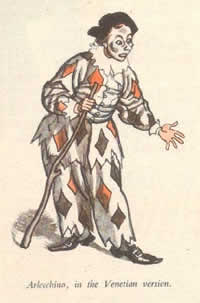
Arlecchino
Arlecchino was accompanied by a character described as a “Zany” who would be the Clown, and who was of little importance at the time. The word Zany still means clown like and comedic.
For many years, pantomime went on altering and although it did not at first really take off in England, mainly because of a prohibition against women appearing onstage (woman were played by boys), some of its characters were assimilated into English theatre, first appearing in William Mountford's Doctor Faustus in 1685.
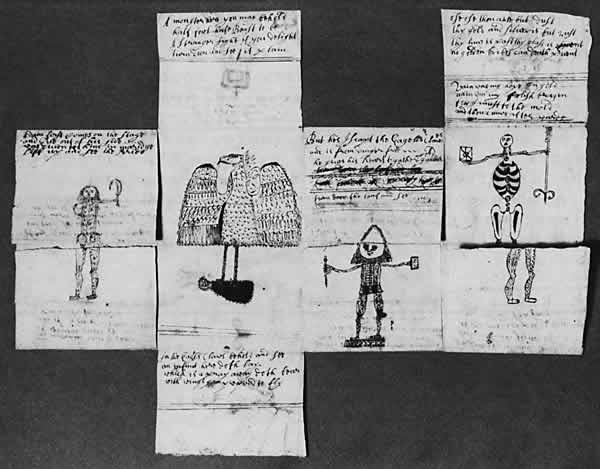
A Harlequinade Manuscript from 1698
By 1700 the Commedia had transformed into a short sequence of comic scenes in which the plot was communicated by mime, slapstick and dance, rather than by dialogue. Considered somewhat vulgar by many (proving a strong link with the Roman Bacchanalia!), they consisted basically of a misunderstanding leading to a comedy brawl and were very popular with audiences.
The first time it happened in anything like the format of the English Pantomime we know today was in 1702, when a mad, merry, topsy-turvy mix up was produced at Drury Lane Theatre, London and a vaguely recognisable Pantomime was born. Drury Lane is still its traditional home. Pantomime must be topsy-turvy in nature or it is not Pantomime.
There were many characters in this old Venetian entertainment but gradually some vanished and others altered into the figures of our own Harlequinade. Pantaloon survived to be the father of the clown, the mean old man of whom everyone made a fool, the Clown most of all, and who tottered about making himself ridiculous and also pursued the lovely figure of Columbine who was the symbolism of feminine charm and grace. All the men in the Harlequinade loved Columbine and wooed her, even the Clown. Harlequin emerged as the most popular character along with Columbine.
There was also a chap called Punchinello, a hunchback who chased women, who has survived to become the longest living Pantomime character, especially in English Seaside resorts. He changed his name to Mr. Punch when he became a puppet who then teamed up with Judy, a hangman, a policeman, a crocodile and Judy’s baby in a very popular spin off show still to be seen today!
The original Arlecchino character wore a distinctive dress and make up. He had a pale face, with dirty marks smeared on it, shabby clothes plentifully patched with various colours, baggy breeches, also patched, big splay feet with ill-fitting shoes and he carried a staff. He was the clown but in the English version Harlequin was never a clown but became instead a figure of magical romance and a King of magic. His dress evolved from that of Arlecchino though. The dirty marks on his face became the black mask which every Harlequin wears and when that mask is turned up he is visible to all and when turned down he is invisible.
In 1717 London, John Rich staged a series of Pantomimes called ‘Harlequin Sorcerer’. In it he combined scenes of Classical mythology with silent scenes telling comic stories of the lovers Harlequin and Columbine and the whole thing was interspersed with songs and dances. This was the first ‘Harlequinade’ and it contained several trick scenes and transformation scenes which happened by the magic of Harlequin’s sword. This item later evolved into a slapstick (two pieces of wood joined with a leather strap and banged together to make a noise) which word has been used ever since to define a certain style of physical comedy.
Originally a silent mime the English developed Harlequin such that he could talk. His costume was stylised enough to use it as a map of his emotions. Colours on his costume denoted his mood when he pointed to it:
Yellow for jealousy
Blue for truth
Red for love
If he wished to become invisible he had merely to point to the Black patch on his costume and lower his mask. The Harlequin had much tradition to remember – he had certain postures called “animations” which all good Harlequins knew – representing certain emotions, but these are lost today.
Over time Harlequin’s own baggy clothes got a bit smarter but still retained the coloured patches, which became geometric lozenges of silver, gold, black, blue and red which finally distinguished Harlequin from Clown. Today the word Harlequin is used for anything with a spangled geometric pattern. The loose clothes kept on to the year 1800 when a man called Byrne, at Drury Lane Theatre wore the skin tight lozenged clothes which from then on became the attire of Harlequin. By degrees Harlequin became King of Pantomime.
In these early Pantomimes there was a little farce or Operetta played first and then at the end, up through a trap-door would shoot Harlequin, his mask down – invisible. He would trip round the stage, beat his magic sword thrice on the ground, wave it in the air and all the characters in the little play were transformed into the characters of the Harlequinade; Clown, Pantaloon, Columbine etc. That first little piece was called “The Opening” and the Harlequinade was the main entertainment.
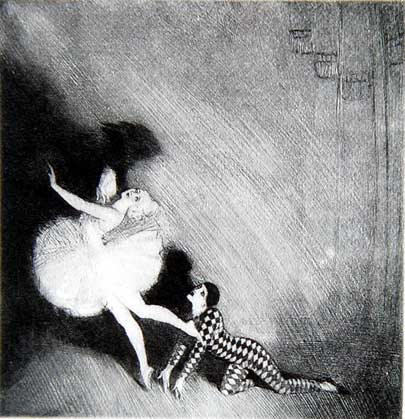
The plot of the generic Harlequinade varies little. Harlequin is generally set a task and he and Columbine would set out to perform it, pursued by Pantaloon and Clown and sometimes another lover who had Pantaloon’s approval. Much of the plot involved a complicated chase scene during which Harlequin would magically transform objects by whacking them with his wooden bat or slapstick. Harlequin could leap through traps, he would work magic, and Columbine, either in a skirt of traditional ballet length, or a very short one which stood out from the waist, with her hair coiled and surmounted with its wreath of flowers was just as lovely as she pirouetted and danced like thistledown.
Columbine
In general a Harlequinade set would consist of a street front cloth, usually containing several stage traps, practical and trick doors and windows. The Clown would be involved in chase scenes where he was called upon to test the limits of his agility, jumping through windows, and re-appearing through trap doors. It was known that the Clown would make certain he tipped the “catchers”, the Stage hands who stood waiting to catch him, with “beer money”. Failure to do so might result in injury! The Clown would steal sausages, chickens and other props which he would stuff into his pockets. There was usually a scene where he would grease the doorstep of the butcher’s shop with butter, to the merriment of the audience, to outwit his pursuers.
Often there was a scene where Clown would divide his stolen food unfairly with an accomplice, this piece of comedy business still remains today in “Dick Whittington”, where Tommy the Cat unfairly divides the bread and fish in Dick’s spotted handkerchief as they rest on Highgate Hill. The Harlequinade did not involve much in the way of dialogue. Here the “Red Hot Poker” reigned supreme, along with tricks and some transformations. A dog would be magically transformed into sausages, a bed became a horse trough, to the surprise of the sleeping victim, Clown would dive into a clock face, which would show no sign of entry. These were accomplished by the “magic” in Harlequin’s staff or wand.
One rendering of the Harlequinade had three scenes – a street scene where the Clown worked havoc and stole everything upon which he could lay his hands. When pursued he just jumped through a window. He shared with his easily fooled Father Pantaloon in the ratio of one for Father and three for himself. But he never fooled Harlequin. Then there would be a highly specialised scene, perhaps in a Turkish Bath, where the fat policeman was reduced to a living skeleton in the hot room- and then “Quiet Lodgings”. In answer to an advertisement the Clown and Pantaloon took what had been described as “Quiet Lodgings” to find a blacksmith’s forge in full use on the ground floor, a first floor given over to a brass band which was always rehearsing, and the second floor to firework manufacturers who had constant explosions. Their efforts at revenge led to a wonderful chase – a “trap” act in which everyone jumped through everything in sight, solid or not – ending up in a soul-satisfying smash in a greenhouse, and totally wrecking it. That was the stuff to give them!
The cast list usually accepted is:
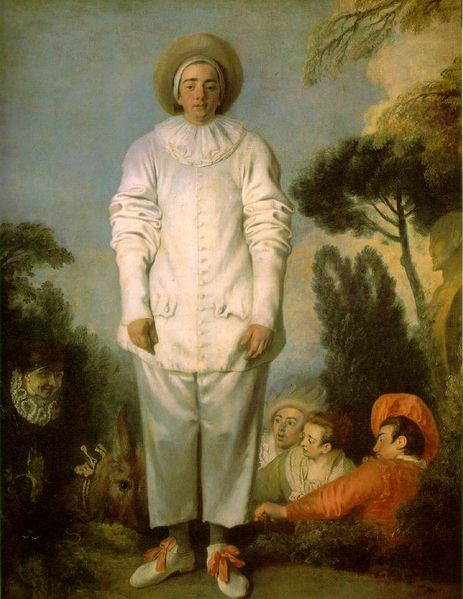
Pierrot
Another lost character is Scaramuccia, also known as Scaramouche. A roguish character who wears a black velvet mask and black trousers, shirt and hat. This pantomime character was invented by a 17th century Italian actor, Tiberio Fiorelli. Scaramouche is a fool, a coward and a boaster and is always outwitted by Harlequin. The character is traditionally dressed in black as a parody of a Spanish nobleman.
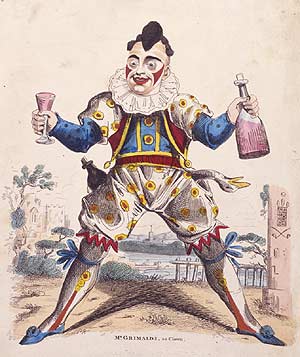
Grimaldi as Scaramouche
A Venetian mask for Scaramouche
The Clown was always there, of course and the time was to come when the Clown was to push Harlequin off his throne and himself become King of Pantomime. This was achieved by a man who was the greatest Clown of all time, Joseph Grimaldi. The costume he wore was the direct descendant of that worn by Arlecchino. For Grimaldi always had a white face, the dirty marks were replaced by crescents and circles of blue and red. He had a kind of jerkin which was also white, but had patches of blue and red all over it. He had quite baggy “trunks” with a succession of little frills, one below the other, and had capacious pockets in which he stowed the goods he pilfered – you could see the string of sausages hanging out – which were the direct descendants of the baggy pants of Arlecchino. He adapted the splay-footed walk when he needed it, and although he used no staff – he had his red hot poker instead, with which to “touch up” the policeman in later years, the watchman in HIS day and anyone else who gave him trouble, to say nothing of poor old Pantaloon. The greatest clown of a more modern era, Charlie Chaplin also had the pale face, with its touch of sadness; there are the ill fitting baggy clothes with their patches, the big splay feet and the uncouth footwear, and instead of the staff a little cane. Even the black marks on the face have their counterpart in that characteristic little Chaplin moustache. So does the traditional costume of the Clown endure.
Grimaldi as Clown
The titles and plots of popular tales, including Fairy Tales began to be used, but whatever the title; the Harlequinade was the most important piece. The first part of the entertainment was usually woven together by an immortal, a Fairy Queen or other God character for example. The story would have a moral tale to tell, but as it was concluding the Fairy would “transform” the characters, whether Robinson Crusoe, Guy Fawkes or Jack the Giant Killer into the well known Harlequinade characters. She would point to her hero and heroine and declaim:
"Lovers stand forth. With you we will begin. You will be fair Columbine, you, Harlequin.".
In the Tale of Guy Fawkes she announced:
"King James there- the bonnie Scottish loon -
you will be a famous child for Pantaloon.
The Guy Fawkes now is saved from rock and axe
I think he should pay the 'powder Tax'.
His Guyish plots blown up, Nay, do not frown
you’ve always been a Guy, now be a Clown!"
In these early Pantomimes the characters would change costume in front of the audience. The Clown would step forward, and, just as Grimaldi always began, would cry "Hello! Here we are again!" a catch phrase copied until the demise of the Harlequinade.
In the 1780s the Pantomime needed a change and as the years went on the "Opening" grew longer and longer and pushed the Harlequinade more and more towards the end. Instead of the Opening and the Harlequinade being kept separate, the opening story grew in length and complexity and only later in the performance were its characters revealed, during a transformation scene, as Harlequin and the other characters of the Harlequinade. From the 1800s on the Harlequinade scenes were interspersed more and more with the scenes of a more serious opening play, usually one taken from myth or folklore.
'Robinson Crusoe' was the first of these combined entertainments and was loosely based on the novel by Daniel Defoe into which the Harlequinade characters then appeared, introducing the Clown, Pantaloon, Harlequin and Columbine directly into the story plot instead of putting on the Harlequinade separately at the end of the evening. Although it usually formed a discrete part of the Pantomime, and could even be performed separately, the Harlequinade was now more commonly inserted into the main production by use of the transformation scenes. The transformation of the set became increasingly spectacular throughout the 1800s and still exits in today's Pantomimes.
This pattern continued well into the 1800s and Pantomimes of this period have double titles, describing the two unconnected stories such as Little Miss Muffet and Little Boy Blue, or Harlequin and Old Daddy Long-Legs.
Hugo Brown and I have catalogued a number of the toy theatre versions of Harlequinades and we have at least these below in some form or other in the Pollock's Toy Museum Archives.
Harlequin And Guy Fawkes
Harlequin And Little King Pippin
Harlequin And Oliver Cromwell
Harlequin And The Giant Helmet
Harlequin Baron Munchausen
Harlequin Dame Crump And The Silver Penny
Harlequin Jack Sheppard
Harlequin Jack The Giant Killer
Harlequin Little Red Riding Hood And Prince Love The Day
Harlequin Riddle Me Re
Harlequin Robin Hood
Harlequin St. George And The Dragon
Harlequin Uncle Tom and Lucy Neal
Many of the above plays also exist in a non-Harlequinade version.
Understanding the 'transformation' theatrical device is essential to understanding the Harlequinade. Characters established in the main story (a young girl, her lover, father, the servant etc.) get into trouble, an impossible situation for which there is no solution, and are transformed by some benign spiritual agent (fairy godmother, 'the gods', etc.) into the characters of the Harlequinade in a strange parallel topsy-turvy world. The purpose of this dramatically was to introduce the comedy and to move the plot along by creating such chaos that the 'powers-that-be' would acquiesce to the union of the lovers just so that order could be restored. At that point the characters were transformed back and the drama proceeded with the happy ending, parades, fireworks, dancing girls, spectacles and general rejoicing.
The tool for effecting the change is another inheritance - Harlequin has his magic bat or slapstick, but it could be a wand, a magic lamp or a host of other things. Sometimes, the transformation is effected by falling asleep, or love potions, or drunkenness (a favourite of Charlie Chaplin's). Chaos must be created (as in A Midsummer Night's Dream with the juice of the flower) in order that all are eventually brought to their senses.
Between 1815 and 1837 the decline of the Harlequinade in favour of what was now the main story telling piece hastened and the death of Grimaldi as Clown did not help. The Clown's role began to be less important and spectacle took over from comedy as the centrepiece.
At this time the Pantomime and Harlequinade were the "desert" to the main course of the evening and just a part of a lengthy programme. Gradually the Fairy Story element of Pantomime came to the fore as the quality of the writing improved. Chiefly responsible was E. L. Blanchard, author of the Drury Lane Pantomimes from 1852-1888. It was during this period that the major changes began to occur. These changes were to transform Pantomime into the template of today's entertainment. Blanchard’s Pantomimes or "annuals" as he called them set the tone for productions everywhere. His first script was for "Jack and the Beanstalk" in 1844 in what is now The Old Vic, London. His first Drury Lane pantomime was in 1852. He established a style of rhyming verse and wit, often topical, that also survives today. Although Pantomimes today rarely have rhyming couplets throughout (with the odd exception) this tradition is carried on by the "immortals" that often begin a Pantomime prologue today in rhyme. The immortals are the vestigial remains of the Harlequinade and, I believe, prior to that, of the Greek and then Roman Gods that were portrayed in the older plays.
The old reliance on Clown and Harlequin was losing its grip now the dialogue was becoming important and other characters were emerging. In 1852 a Miss Ellington had become one of the first "Principal Boys" playing the Prince in "The Good Woman In The Wood" at the Lyceum Theatre. By the 1860’s the role of Principal Boy was established and the equally new role of 'Dame' was beginning to threaten Harlequinade's clown even further.
By the 1850s Pantomimes had become associated with Christmas only and spoken dialogue was an essential ingredient with the importance of the main story, once only a short introduction to the Harlequinade had outgrown the Harlequinade itself. The Harlequinade scenes got shorter and shorter and the actors who played in them were paid less and less!
By the mid 1800's the "Transformation Scenes" – elaborate and spectacular scenic changes and tableaux became the most important part of these early pantomimes. In some cases to the detriment of the Harlequinade comedy scenes some actors complained. William Beverley, in 1849 created a scene called "The Island of Jewels" where a palm tree gradually dropped its leaves to reveal bejewelled fairy after fairy who then created a tableaux holding aloft a jewelled crown. His spectacle was widely copied. Managements vied with each other to create the most lavish transformations. Transparent curtains would reveal "The Bower of Bliss", or "The Realm of Delight".
In 1860 the Haymarket theatre in London produced working fountains on stage in a bid to outdo the rivals. Scenery was of great importance to the audience in these days before photography, film and media coverage. To the onlooker in London it might be his or her first ever glimpse of the open country, or of foreign temples or the wilds of the Scottish moors.
The tradition of a spectacular scene or transformation still exists in today's pantomimes- the jewelled cave in "Aladdin", the revealing of Cinderella's Coach". Dick Whittington's dream sequence on Highgate Hill are all direct descendants of Mr. Beverley's creations.
A Covent Garden Theatre Harlequinade
By 1870 Pantomimes were lasting three hours or more and were being targeted on audiences of children. They became more and more lavish, with flying ballets, spectacular scenery and casts of hundreds but the entire Harlequinade had been reduced to a mere chase scene in the main story.
From the many varied and titled subjects, the theatres began to restrict themselves to just a few favourite stories. The popular ones being "Cinderella", "Dick Whittington", "Jack and the Beanstalk" along with "Mother Goose", "Aladdin", "Robinson Crusoe", "Babes in the Wood" "Goody Two Shoes". Of these the intrinsically British story was "Babes in the Wood", which was eventually to merge with "Robin Hood", "Robinson Crusoe", "St. George and the Dragon" and "Gulliver’s Travels". The other subjects were imported from the French court like Perrault's "Cinderella", "Sleeping Beauty", "Red Riding Hood" and "Hop O’My Thumb". Red Riding Hood itself dates back to Roman times and was then utilized by the Brother's Grimm. "Puss In Boots" dates from an Italian version of 1534 utilized by Perrault. "Aladdin" had begun as one of the Tales from the Arabian Nights, and emerged as a serious play in London in 1788, and with Grimaldi in 1813. Robin Hood joined forces with the "Babes In The Wood" at Drury Lane Theatre in 1857. The first "Dick Whittington" Pantomime seems to be at Covent Garden in 1814. "Goody Two Shoes" emerges from the pen of Oliver Goldsmith in 1765. With it's slight plot which merges Nursery characters like Little Boy Blue as the playmate of "Goody" and "Little Bo Peep" as Jack Horner's sweetheart it was eventually dropped, the confusion of plot being the chief reason. Pantomime adapted and enveloped all of these cultures and presented them to the English public in a standard format.
However, in 1879 Augustus Harris, manager of Drury Lane introduced the first Music Hall stars into Pantomimes and in 1883 the one remaining Harlequinade scene was dropped.
The legacy of the Harlequinade still exists in the transformation scenes, slapstick and chase scenes of modern day English Pantomimes even if the Harlequinade troupe left the building a century ago…
Compiled by Paul J. Weighell
September 2006 London
Compiled by Paul J. Weighell
September 2006 London
First I must mention that the word Pantomime, originally from the Greek and meaning "An Imitator of Things" means something different to the residents of the United States than to us here in England. I gather that to Americans it means a "Mime" i.e. a performer who needs no words to express himself; This is the literal and original meaning of the word but to the English however 'a Pantomime' is a performance of a certain sort rather than a performer of a certain sort.
Today's Pantomimes are streamlined and very modern but Pantomime itself is very old, probably pre-historic as the mid-winter festival to cheer things up when the days were short and nights were long. Its current performances are always at Christmas which if you are reading this in Tobago is when England's coldest and darkest period happens. Performing Pantomime at that time keeps certain old pagan pre-Christian traditions alive. It still links us with the old Roman feast of Saturnalia when everything went Topsy-Turvy and men dressed as women and women as men, slaves were masters and master were slaves – from whence comes the modern Pantomime character of Principal Boy, always played by a woman, and the Pantomime Dame, always played by a man. Pantomime still includes Demon Kings and Fairy Queens kept to the left and right of the stage respectively because those were the sides of good and evil in the medieval mystery and morality plays.
The Pantomime in England is now a mere shadow of its former self and remains only as a highly stylised and lavish fairy tale or fantasy based performance acted out at Christmas and for children. It once had far more serious and grown up audiences and has evolved from at least as far back as the ancient Greeks and come down to us via ancient Romans, Venetians, Italians and even the French. It has evolved a good deal over the last few thousand years and especially since 1577 when it first appeared in England. It is not a British thing at all but a truly English form of dramatic art appearing nowhere else than England and a few parts of our Commonwealth of 53 ex-British Empire countries.
A 'Harlequinade' may be best described by saying it is a particular part of Pantomime although it may also be performed alone. Sadly, the Harlequinade has not been performed in Pantomime for more than 100 years and, other than in toy theatre copies, has not been seen for at least that long. It is a sobering thought that Toy Theatres are the last place that the Harlequinades survive.
Our English Pantomimes and Harlequinades come directly from the Venetian travelling comedy shows of the “Commedia Dell’Arte”. The origins of these are lost in the mists of time but are thought to be the remainder of the ancient Roman Bacchanalia (Bacchus being the God of strong drink!) comedies of Plautus and Terence. These Roman performances were often so low, drunken, bawdy and rowdy that they were banished by the onslaught of Christianity into ancient Mediterranean civilisation.
The Roman performances were themselves translations of the lost Greek comedies of the fourth century BC. These were stylised comedic performances included improvisation, dance and knockabout comedy built around storylines involving romantic intrigues, slaves outwitting masters, old men lusting after pretty girls and the annoying but inescapable intervention of the Gods in the affairs of mortal men.
In some Harlequinade plays the Harlequin characters are pretty obviously immortals who adopt human form, act out the play and then transform back to their Pantomime characters. I believe that in one Harlequinade version (Guy Fawkes?) the dead lead character comes back to life and escapes from prison as Harlequin, difficult to do if one is not immortal!
Somehow the ancient traditional performances hung around the East Italian / Greek / Turkish area of the Mediterranean and we now know they reappeared in 15th Century Venice with the popular theatrical entertainment known as the “Commedia Dell’Arte”. These performances featured specific characters, some of which still exist in spirit in today’s Pantomimes, drawn from different regions of Italy. “Spaviento” was Neapolitan and a boaster and braggart. “Gingurto” and “Coviello” were a double act of simpletons. From Milan came the character of “Beltrama” and another simpleton who joined in was “Gelsomino”, a dandy.
The “Commedia Dell’Arte” eventually travelled across Europe to Paris and then to Britain. The dialogue was always improvised but the characters and the visual comedy routines remained standard. A bit like a TV soap opera! The show could be understood even if one could not hear the dialogue as it was supremely simple and visual. It must have made a most welcome change from the Christian derived morality plays of the period. The Commedia was a successful format with a set of stock characters with specific attributes, costumes and behavioural patterns which didn't vary. Everything else did including the sets, the basic plot or scenario, the props and names that were new each time. Topical events and issues of the day might be commented upon and every opportunity for spectacle was used.
The travelling show was a great hit and the first record of such a commedia troupe appearing in England was in 1577 and there is a performance recorded as being before Queen Elizabeth I in 1602. Harlequin made his first appearance, as such, in a Masque performed before King Charles 1st at Whitehall, London in 1637. The chief character in the show was a clown whose part was played by a man named ‘Arlecchino’ but the English found the name too difficult to pronounce and changed it to ‘Harlequin’ which it has been ever since.
Arlecchino was accompanied by a character described as a “Zany” who would be the Clown, and who was of little importance at the time. The word Zany still means clown like and comedic.
For many years, pantomime went on altering and although it did not at first really take off in England, mainly because of a prohibition against women appearing onstage (woman were played by boys), some of its characters were assimilated into English theatre, first appearing in William Mountford's Doctor Faustus in 1685.
By 1700 the Commedia had transformed into a short sequence of comic scenes in which the plot was communicated by mime, slapstick and dance, rather than by dialogue. Considered somewhat vulgar by many (proving a strong link with the Roman Bacchanalia!), they consisted basically of a misunderstanding leading to a comedy brawl and were very popular with audiences.
The first time it happened in anything like the format of the English Pantomime we know today was in 1702, when a mad, merry, topsy-turvy mix up was produced at Drury Lane Theatre, London and a vaguely recognisable Pantomime was born. Drury Lane is still its traditional home. Pantomime must be topsy-turvy in nature or it is not Pantomime.
There were many characters in this old Venetian entertainment but gradually some vanished and others altered into the figures of our own Harlequinade. Pantaloon survived to be the father of the clown, the mean old man of whom everyone made a fool, the Clown most of all, and who tottered about making himself ridiculous and also pursued the lovely figure of Columbine who was the symbolism of feminine charm and grace. All the men in the Harlequinade loved Columbine and wooed her, even the Clown. Harlequin emerged as the most popular character along with Columbine.
There was also a chap called Punchinello, a hunchback who chased women, who has survived to become the longest living Pantomime character, especially in English Seaside resorts. He changed his name to Mr. Punch when he became a puppet who then teamed up with Judy, a hangman, a policeman, a crocodile and Judy’s baby in a very popular spin off show still to be seen today!
The original Arlecchino character wore a distinctive dress and make up. He had a pale face, with dirty marks smeared on it, shabby clothes plentifully patched with various colours, baggy breeches, also patched, big splay feet with ill-fitting shoes and he carried a staff. He was the clown but in the English version Harlequin was never a clown but became instead a figure of magical romance and a King of magic. His dress evolved from that of Arlecchino though. The dirty marks on his face became the black mask which every Harlequin wears and when that mask is turned up he is visible to all and when turned down he is invisible.
In 1717 London, John Rich staged a series of Pantomimes called ‘Harlequin Sorcerer’. In it he combined scenes of Classical mythology with silent scenes telling comic stories of the lovers Harlequin and Columbine and the whole thing was interspersed with songs and dances. This was the first ‘Harlequinade’ and it contained several trick scenes and transformation scenes which happened by the magic of Harlequin’s sword. This item later evolved into a slapstick (two pieces of wood joined with a leather strap and banged together to make a noise) which word has been used ever since to define a certain style of physical comedy.
Originally a silent mime the English developed Harlequin such that he could talk. His costume was stylised enough to use it as a map of his emotions. Colours on his costume denoted his mood when he pointed to it:
Blue for truth
Red for love
If he wished to become invisible he had merely to point to the Black patch on his costume and lower his mask. The Harlequin had much tradition to remember – he had certain postures called “animations” which all good Harlequins knew – representing certain emotions, but these are lost today.
Over time Harlequin’s own baggy clothes got a bit smarter but still retained the coloured patches, which became geometric lozenges of silver, gold, black, blue and red which finally distinguished Harlequin from Clown. Today the word Harlequin is used for anything with a spangled geometric pattern. The loose clothes kept on to the year 1800 when a man called Byrne, at Drury Lane Theatre wore the skin tight lozenged clothes which from then on became the attire of Harlequin. By degrees Harlequin became King of Pantomime.
In these early Pantomimes there was a little farce or Operetta played first and then at the end, up through a trap-door would shoot Harlequin, his mask down – invisible. He would trip round the stage, beat his magic sword thrice on the ground, wave it in the air and all the characters in the little play were transformed into the characters of the Harlequinade; Clown, Pantaloon, Columbine etc. That first little piece was called “The Opening” and the Harlequinade was the main entertainment.
The plot of the generic Harlequinade varies little. Harlequin is generally set a task and he and Columbine would set out to perform it, pursued by Pantaloon and Clown and sometimes another lover who had Pantaloon’s approval. Much of the plot involved a complicated chase scene during which Harlequin would magically transform objects by whacking them with his wooden bat or slapstick. Harlequin could leap through traps, he would work magic, and Columbine, either in a skirt of traditional ballet length, or a very short one which stood out from the waist, with her hair coiled and surmounted with its wreath of flowers was just as lovely as she pirouetted and danced like thistledown.
In general a Harlequinade set would consist of a street front cloth, usually containing several stage traps, practical and trick doors and windows. The Clown would be involved in chase scenes where he was called upon to test the limits of his agility, jumping through windows, and re-appearing through trap doors. It was known that the Clown would make certain he tipped the “catchers”, the Stage hands who stood waiting to catch him, with “beer money”. Failure to do so might result in injury! The Clown would steal sausages, chickens and other props which he would stuff into his pockets. There was usually a scene where he would grease the doorstep of the butcher’s shop with butter, to the merriment of the audience, to outwit his pursuers.
Often there was a scene where Clown would divide his stolen food unfairly with an accomplice, this piece of comedy business still remains today in “Dick Whittington”, where Tommy the Cat unfairly divides the bread and fish in Dick’s spotted handkerchief as they rest on Highgate Hill. The Harlequinade did not involve much in the way of dialogue. Here the “Red Hot Poker” reigned supreme, along with tricks and some transformations. A dog would be magically transformed into sausages, a bed became a horse trough, to the surprise of the sleeping victim, Clown would dive into a clock face, which would show no sign of entry. These were accomplished by the “magic” in Harlequin’s staff or wand.
One rendering of the Harlequinade had three scenes – a street scene where the Clown worked havoc and stole everything upon which he could lay his hands. When pursued he just jumped through a window. He shared with his easily fooled Father Pantaloon in the ratio of one for Father and three for himself. But he never fooled Harlequin. Then there would be a highly specialised scene, perhaps in a Turkish Bath, where the fat policeman was reduced to a living skeleton in the hot room- and then “Quiet Lodgings”. In answer to an advertisement the Clown and Pantaloon took what had been described as “Quiet Lodgings” to find a blacksmith’s forge in full use on the ground floor, a first floor given over to a brass band which was always rehearsing, and the second floor to firework manufacturers who had constant explosions. Their efforts at revenge led to a wonderful chase – a “trap” act in which everyone jumped through everything in sight, solid or not – ending up in a soul-satisfying smash in a greenhouse, and totally wrecking it. That was the stuff to give them!
The cast list usually accepted is:
Columbine: a pretty young girlFor many years the figure of Pierrot (Pedrolino) was there but not the cheery laughing Pierrot still to be met sometimes at the seaside, but a rather sad, forlorn figure, breaking his heart for the love of the fickle and capricious Columbine who was won by Harlequin in the end. Bakken literature claims that this character is more than 4,000 years old, and originated in Turkey. It is also claimed that in ancient times, the broad red mouth of the character was created by physically cutting the mouth to make it larger.
Pantaloon: a rich and miserly merchant who is frequently the father of one of the others. He also employs Arlecchino and treats him cruelly.
Harlequin: a dancer in love with Columbine
Clown: the mischief maker who is son or servant to Pantaloon but really supports the lovers
Policeman: the venal official there only to heighten the action by threat of punishment and imposition of society's conventions.
Another lost character is Scaramuccia, also known as Scaramouche. A roguish character who wears a black velvet mask and black trousers, shirt and hat. This pantomime character was invented by a 17th century Italian actor, Tiberio Fiorelli. Scaramouche is a fool, a coward and a boaster and is always outwitted by Harlequin. The character is traditionally dressed in black as a parody of a Spanish nobleman.
The Clown was always there, of course and the time was to come when the Clown was to push Harlequin off his throne and himself become King of Pantomime. This was achieved by a man who was the greatest Clown of all time, Joseph Grimaldi. The costume he wore was the direct descendant of that worn by Arlecchino. For Grimaldi always had a white face, the dirty marks were replaced by crescents and circles of blue and red. He had a kind of jerkin which was also white, but had patches of blue and red all over it. He had quite baggy “trunks” with a succession of little frills, one below the other, and had capacious pockets in which he stowed the goods he pilfered – you could see the string of sausages hanging out – which were the direct descendants of the baggy pants of Arlecchino. He adapted the splay-footed walk when he needed it, and although he used no staff – he had his red hot poker instead, with which to “touch up” the policeman in later years, the watchman in HIS day and anyone else who gave him trouble, to say nothing of poor old Pantaloon. The greatest clown of a more modern era, Charlie Chaplin also had the pale face, with its touch of sadness; there are the ill fitting baggy clothes with their patches, the big splay feet and the uncouth footwear, and instead of the staff a little cane. Even the black marks on the face have their counterpart in that characteristic little Chaplin moustache. So does the traditional costume of the Clown endure.
The titles and plots of popular tales, including Fairy Tales began to be used, but whatever the title; the Harlequinade was the most important piece. The first part of the entertainment was usually woven together by an immortal, a Fairy Queen or other God character for example. The story would have a moral tale to tell, but as it was concluding the Fairy would “transform” the characters, whether Robinson Crusoe, Guy Fawkes or Jack the Giant Killer into the well known Harlequinade characters. She would point to her hero and heroine and declaim:
"Lovers stand forth. With you we will begin. You will be fair Columbine, you, Harlequin.".
In the Tale of Guy Fawkes she announced:
"King James there- the bonnie Scottish loon -
you will be a famous child for Pantaloon.
The Guy Fawkes now is saved from rock and axe
I think he should pay the 'powder Tax'.
His Guyish plots blown up, Nay, do not frown
you’ve always been a Guy, now be a Clown!"
In these early Pantomimes the characters would change costume in front of the audience. The Clown would step forward, and, just as Grimaldi always began, would cry "Hello! Here we are again!" a catch phrase copied until the demise of the Harlequinade.
In the 1780s the Pantomime needed a change and as the years went on the "Opening" grew longer and longer and pushed the Harlequinade more and more towards the end. Instead of the Opening and the Harlequinade being kept separate, the opening story grew in length and complexity and only later in the performance were its characters revealed, during a transformation scene, as Harlequin and the other characters of the Harlequinade. From the 1800s on the Harlequinade scenes were interspersed more and more with the scenes of a more serious opening play, usually one taken from myth or folklore.
'Robinson Crusoe' was the first of these combined entertainments and was loosely based on the novel by Daniel Defoe into which the Harlequinade characters then appeared, introducing the Clown, Pantaloon, Harlequin and Columbine directly into the story plot instead of putting on the Harlequinade separately at the end of the evening. Although it usually formed a discrete part of the Pantomime, and could even be performed separately, the Harlequinade was now more commonly inserted into the main production by use of the transformation scenes. The transformation of the set became increasingly spectacular throughout the 1800s and still exits in today's Pantomimes.
This pattern continued well into the 1800s and Pantomimes of this period have double titles, describing the two unconnected stories such as Little Miss Muffet and Little Boy Blue, or Harlequin and Old Daddy Long-Legs.
Hugo Brown and I have catalogued a number of the toy theatre versions of Harlequinades and we have at least these below in some form or other in the Pollock's Toy Museum Archives.
Harlequin And Guy Fawkes
Harlequin And Little King Pippin
Harlequin And Oliver Cromwell
Harlequin And The Giant Helmet
Harlequin Baron Munchausen
Harlequin Dame Crump And The Silver Penny
Harlequin Jack Sheppard
Harlequin Jack The Giant Killer
Harlequin Little Red Riding Hood And Prince Love The Day
Harlequin Riddle Me Re
Harlequin Robin Hood
Harlequin St. George And The Dragon
Harlequin Uncle Tom and Lucy Neal
Many of the above plays also exist in a non-Harlequinade version.
Understanding the 'transformation' theatrical device is essential to understanding the Harlequinade. Characters established in the main story (a young girl, her lover, father, the servant etc.) get into trouble, an impossible situation for which there is no solution, and are transformed by some benign spiritual agent (fairy godmother, 'the gods', etc.) into the characters of the Harlequinade in a strange parallel topsy-turvy world. The purpose of this dramatically was to introduce the comedy and to move the plot along by creating such chaos that the 'powers-that-be' would acquiesce to the union of the lovers just so that order could be restored. At that point the characters were transformed back and the drama proceeded with the happy ending, parades, fireworks, dancing girls, spectacles and general rejoicing.
The tool for effecting the change is another inheritance - Harlequin has his magic bat or slapstick, but it could be a wand, a magic lamp or a host of other things. Sometimes, the transformation is effected by falling asleep, or love potions, or drunkenness (a favourite of Charlie Chaplin's). Chaos must be created (as in A Midsummer Night's Dream with the juice of the flower) in order that all are eventually brought to their senses.
Between 1815 and 1837 the decline of the Harlequinade in favour of what was now the main story telling piece hastened and the death of Grimaldi as Clown did not help. The Clown's role began to be less important and spectacle took over from comedy as the centrepiece.
At this time the Pantomime and Harlequinade were the "desert" to the main course of the evening and just a part of a lengthy programme. Gradually the Fairy Story element of Pantomime came to the fore as the quality of the writing improved. Chiefly responsible was E. L. Blanchard, author of the Drury Lane Pantomimes from 1852-1888. It was during this period that the major changes began to occur. These changes were to transform Pantomime into the template of today's entertainment. Blanchard’s Pantomimes or "annuals" as he called them set the tone for productions everywhere. His first script was for "Jack and the Beanstalk" in 1844 in what is now The Old Vic, London. His first Drury Lane pantomime was in 1852. He established a style of rhyming verse and wit, often topical, that also survives today. Although Pantomimes today rarely have rhyming couplets throughout (with the odd exception) this tradition is carried on by the "immortals" that often begin a Pantomime prologue today in rhyme. The immortals are the vestigial remains of the Harlequinade and, I believe, prior to that, of the Greek and then Roman Gods that were portrayed in the older plays.
The old reliance on Clown and Harlequin was losing its grip now the dialogue was becoming important and other characters were emerging. In 1852 a Miss Ellington had become one of the first "Principal Boys" playing the Prince in "The Good Woman In The Wood" at the Lyceum Theatre. By the 1860’s the role of Principal Boy was established and the equally new role of 'Dame' was beginning to threaten Harlequinade's clown even further.
By the 1850s Pantomimes had become associated with Christmas only and spoken dialogue was an essential ingredient with the importance of the main story, once only a short introduction to the Harlequinade had outgrown the Harlequinade itself. The Harlequinade scenes got shorter and shorter and the actors who played in them were paid less and less!
By the mid 1800's the "Transformation Scenes" – elaborate and spectacular scenic changes and tableaux became the most important part of these early pantomimes. In some cases to the detriment of the Harlequinade comedy scenes some actors complained. William Beverley, in 1849 created a scene called "The Island of Jewels" where a palm tree gradually dropped its leaves to reveal bejewelled fairy after fairy who then created a tableaux holding aloft a jewelled crown. His spectacle was widely copied. Managements vied with each other to create the most lavish transformations. Transparent curtains would reveal "The Bower of Bliss", or "The Realm of Delight".
In 1860 the Haymarket theatre in London produced working fountains on stage in a bid to outdo the rivals. Scenery was of great importance to the audience in these days before photography, film and media coverage. To the onlooker in London it might be his or her first ever glimpse of the open country, or of foreign temples or the wilds of the Scottish moors.
The tradition of a spectacular scene or transformation still exists in today's pantomimes- the jewelled cave in "Aladdin", the revealing of Cinderella's Coach". Dick Whittington's dream sequence on Highgate Hill are all direct descendants of Mr. Beverley's creations.
By 1870 Pantomimes were lasting three hours or more and were being targeted on audiences of children. They became more and more lavish, with flying ballets, spectacular scenery and casts of hundreds but the entire Harlequinade had been reduced to a mere chase scene in the main story.
From the many varied and titled subjects, the theatres began to restrict themselves to just a few favourite stories. The popular ones being "Cinderella", "Dick Whittington", "Jack and the Beanstalk" along with "Mother Goose", "Aladdin", "Robinson Crusoe", "Babes in the Wood" "Goody Two Shoes". Of these the intrinsically British story was "Babes in the Wood", which was eventually to merge with "Robin Hood", "Robinson Crusoe", "St. George and the Dragon" and "Gulliver’s Travels". The other subjects were imported from the French court like Perrault's "Cinderella", "Sleeping Beauty", "Red Riding Hood" and "Hop O’My Thumb". Red Riding Hood itself dates back to Roman times and was then utilized by the Brother's Grimm. "Puss In Boots" dates from an Italian version of 1534 utilized by Perrault. "Aladdin" had begun as one of the Tales from the Arabian Nights, and emerged as a serious play in London in 1788, and with Grimaldi in 1813. Robin Hood joined forces with the "Babes In The Wood" at Drury Lane Theatre in 1857. The first "Dick Whittington" Pantomime seems to be at Covent Garden in 1814. "Goody Two Shoes" emerges from the pen of Oliver Goldsmith in 1765. With it's slight plot which merges Nursery characters like Little Boy Blue as the playmate of "Goody" and "Little Bo Peep" as Jack Horner's sweetheart it was eventually dropped, the confusion of plot being the chief reason. Pantomime adapted and enveloped all of these cultures and presented them to the English public in a standard format.
However, in 1879 Augustus Harris, manager of Drury Lane introduced the first Music Hall stars into Pantomimes and in 1883 the one remaining Harlequinade scene was dropped.
The legacy of the Harlequinade still exists in the transformation scenes, slapstick and chase scenes of modern day English Pantomimes even if the Harlequinade troupe left the building a century ago…
Compiled by Paul J. Weighell
September 2006 London
Monday, May 04, 2020
May Fayre Memories Documentary
For 45 years Maggie Pinhorn and Alternative Arts have organised the Covent Garden May Fayre and Puppet Festival. In this video Punch and Judy professors, puppeteers, entertainers and puppet builders discuss what makes the day so magical, why people travel from across the globe to attend, and thank Maggie for her unparalleled contribution to British puppetry.
Thursday, December 12, 2013
Doctor Who in the Small
![]() |
| Scene from BBC 2013 Doctor Who Christmas Special: The Doctor contemplates alien with his sonic screwdriver |
![]() |
| Doctor Puppet, created by Alison Stern |
With this being the 50th anniversary of Doctor Who, there are many creative projects and performances being inspired by the Doctor. This includes projects that take the doctor to the small stage, as well as to the world of stop-motion film shorts.
The creativity of the people behind these projects boggles the mind. Even the official Doctor Who program itself will be featuring a Punch-and-Judy-like puppet story in this year's Christmas Special!
Sunday, December 15, 2019
Old-Time "Moving Pictures"
A listing of 16 different late 19th-century "Boy's Own Panoramas" for home entertainment, from H. G. Clarke and Co. in London. These 19th-century crankies include moving panoramas about John Gilpin, Dick Turpin, Punchinello, Punch and Judy, and views of the Thames embankment, the Oxford and Cambridge boat race, and a state procession with Queen Victoria. From the back of a racist galanty (shadow figure) show script inspired by Christy's Minstrels (an American blackface minstrel group which toured in England from 1857 to the turn of the century). Thanks Matthew Isaac Cohen for sharing this source.
Friday, February 07, 2020
Saturday, July 12, 2008
Wednesday, June 16, 2010
GSW9: Final Festival Report

Tess Elliott had one more report she sent me last night from the final hours of the Festival.
Considering that Tess lost her DSL access for almost half the festival - and my satellite access has been capped the last 4 days due to my going over our threshold (yes, satellite has broadband caps...don't get me started...!) - it's been a struggle for this website to get reports out on a timely basis. Thank you, Dear Readers, for being patient.
Now, here is the final report - Enjoy!
NOTE FROM TRISH: I concur - an amazing festival, indeed!
“Fiesta Graveyard” from Mexico City was written by Mercedes Go'mez Benet, who also played a small harp. The puppeteers were Alejandro Beni'tez and Mauricio Martinez of Facto Teatro, who also performed songs. The other musician was Gerardo Tame'z. Part of the success of their show is that the music and sound effects were just stunning. They did the show with some English translation, but most of it you could follow once they set the scene. A man, Procopio, has died a natural death, and to reach the eternal Fiesta, he must go through some supernatural tests. A hairless dog that in some cultures had mystical properties (and in others was food) becomes his guide, only the man first must realize he is dead. Each scene change is punctuated by a supernatural interval of ghostly winds done beautifully with various pipes which ends with more music bringing in the next scene. The guitar and harp are very wonderfully done, so that it feels like an orchestra. They accompany him fighting a supernatural lizard, mountains crashing together, and other tests.
The performers were very funny and fierce with a mixture of good puppetry and making great faces as they tell the story. Oh the weeping when poor Procopio dies! And of course, it ends with a Day of the Dead altar, which is one of my favorite traditions. After several years of painting in the New Mexico desert at Halloween time, I got to know a lot about the tradition of Dios de Los Muertos, and now make my own home altar to remember those who I have lost. It is a very friendly, warm way to remember your loved ones, and the home altars are really quite beautiful. This was such a happy surprise for me to see the show was about this great tradition. It was magical and mesmerizing (and they, too, made their own jokes about Arizona). I hope to see this company again. It gave me more insight into a tradition I already love.
Shoddy Puppet Company's leader Morgan FitzPatrick Andrews was in the Saturday symposium, so I looked forward to seeing his company. They performed “Fables of Light and Falling” in an interesting looking tent, with scenes painted on the outside, and a window flap to be raised for the small stage. The other puppeteers were Zac Palladino, Leslie Rogers, and Kestrel Plump. There were four interwoven stories, that involved a mule who was mistaken for a woman, a wooden man, two people made of straw, a scarecrow man (who later meets the straw woman who has a stone tied around her belly), and how the straw man did not want to fight in a war. He ran from one, but was absorbed by the Earth for signing a paper that he would pay for someone else to fight when another war is declared. It is a morality tale because the man who was taken in his place was the wooden man who helped him when the scarecrow ran from the first war. Crows are the device that take people and become frightening symbols. The scarecrow is afraid of them. I remembered thinking they were bullies as a little girl and the truth is crows recognize people and carry grudges.I am very glad I didn't throw stones at the ones who perched on my swingset! This is also a political tale about war, and everyone is given a silver pencil as a symbol of the right person signing the right paper at the right time to prevent wars and other terrible things. Mr. Andrews was a musical narrator, with a Woody Guthrie sort of persona of folk music and plain speaking, telling the stories and playing, while the little tent twirled with activity, as puppets popped up out of slashes in the fabric set, and then up on the stage to tell the story. That is some close quarters to perform in, though it reminded me of the old seaside Punch and Judy theaters that were worn ON the puppeteer. It's certainly handy to bring your own theater.
Often, I find myself disliking being lectured to about what is right and wrong by sidewalk petitioners and protestors, but the charm of the puppeteers and the humor in the stories (all the political satire) are a delightful way to present controversial points of view. Unfortunately, they are preaching to the choir in Brooklyn. This is an artistic community that in general hates war, and banks foreclosing (I have memories of some small farms going down when I was a 4H girl in Indiana) and I like the way the puppets can charm their way into telling you their point of view. Protesters don't have that luxury, to make people laugh while they get them to listen. I like the puppet way better! I think if I ever manned a petition table, it would have to have puppets handing out pens instead of big angry signs and in-your-face criers of protest. Maybe the liberal world ought to think of this when they want to change something?
The Cosmic Bicycle Theater, performing “Clockworks Universalis.” This company has a terrific website except that while I love playing with it, I still want more information and pictures of performances. They have a long record of performing, even when “steampunk” was not really a genre well known, but one they may have helped develop. So when I saw their set, and the derby clad automata-like performers sitting on either side I was in heaven. Only trouble is that it took a third of the performance to see that their set was a wonderful 3-dimensional collage of all sorts of old clip art, much of which came from Dover Publications, which I pay homage to in much of my decoupage work. It reminded me a lot of the collage work of automata maker Simon Venus (am a huge automata fan). Check out Cabaret Mechanical Theater's little flick on YouTube made by Gaz Cobain - Venus's piece is the first one - and you will see why I connect the two. I am playing with my own automata design kit, which makes my head explode on a regular basis.
So while I was mesmerized by the puppeteers, I must admit one of their devices, the Victorian engraved pointing hand zipping in and out, sometimes doing some damage, did interfere with my mindset, because when I see that device my brain goes : Blue Meanie Flying Glove, or “the Fickle Finger of Fate” award by Rowan and Martin. It made me hold back laughter, and I wonder if maybe it was okay to laugh. We heard someone say not to clap, that they needed silence. Clockwork is noisy. It was beautiful but I wanted noise.
The set is a 3D collage that sits in a long box lit with oil lamps, behind a many-paned window with something foggy on the glass. The device of wiping off the glass is really cool, until you have had to watch the window cleaning six or seven times. The collage is beautiful, and tells a creation story that is artistic and funny when the two puppeteers get going. It was well-timed, and the only thing I wished for was larger panes of glass and less window cleaning.Great Small Works film, “White Pajamas” was a lovely little film done by Jenny Romaine with Dr. Barbara Kirshenblatt-Gimblett. It is the paintings of Mayer Kirshenblatt about his childhood in Poland, and they are wonderful naïve paintings of the local city life and how his father tried to get a boy after seven daughters. He is told by the nearby Rebbe to dress the baby in white so that the Angel of death won't take him, and how that boy always wore white pajamas. The scenes are just beautiful. There is the inevitable memory of the Holocaust, but I really loved the sweet paintings of a happier life—one that never seems to be covered enough.
It was a perfect ending to all the marvelous, frantic and funny dreams of utopia, and transformed anger of the toy theater performances. Especially giving it that “citizen of the world” passport stamp for an audience who passionately supports seeing work from other countries.
Bravo, and Brava to Great Small Works!
Subscribe to:
Posts (Atom)