Showing posts with label art. Show all posts

Thursday, December 24, 2020

Simon Armitage Hansel and Gretel, Re-imagined

A "newish" book (published in 2019) from poet laureate Simon Armitage, in collaboration with artist Clive Hicks-Jenkins. 

Simon Armitage’s extended narrative poem uses the well-known framework of the Brothers Grimm tale but gives us a new contemporary interpretation and focus. This is a darker, glittering Hansel & Gretel fairy story for the 21st century, of refugees, bombed villages, homelessness, a landscape where nothing is quite as it seems, but of humanity, humour and hope too. 

The powerful story is illustrated by the visual creations of artist Clive Hicks-Jenkins. His compelling Hansel & Gretel characters have appeared as prints, and as a Toy Theatre for Benjamin Pollock's Toyshop and re-imagined here using the imagery of the toy box of mid-century wooden puppets, villages and building blocks in creating a unique, contemporary fairytale landscape.

Wednesday, October 30, 2019

Second Annual Winnipeg Crankie Festival


The 2nd Annual Winnipeg Crankie Festival, taking place at Crescent Fort Rouge United Church, NOVEMBER 8-10th, 2019 promises to expand on the inaugural edition as a new, interactive and participatory festival, where audience members can immerse themselves in music and art; on and off stage.

 We are honoured to dedicate this year's festival to Canadian Folk Music Pioneer, Mitch Podolak.

To find out more, visit the festival website here, or check out the poster, below...

Crankie Creative Commercial

Sunday, February 11, 2018

Enchanted Dolls


I love making dolls because it allows me to work with several mediums at once. Making dolls is a creative process that combines the disciplines of industrial design, sculpting, ceramics, painting, engineering, drawing, engraving, jewelry making and textiles. It generates a whole that is greater and richer than the sum of each comprising medium put together. 
- Marina Bychkova

Saturday, December 10, 2016

Mouse Shops by Anonymouse

"Am I too late?" Mr. Mouse wonders.  It looks like he is - the door is locked, the lights are out, and no one answers...


"Mrs. Mouse will be very disappointed," Mr. Mouse mutters to himself as he leaves...
The mouse shop in-the-making.  The creative process and attention to detail are amazing!
You may think you’re a nice, considerate person.

But ask yourself: have you ever considered the appalling lack of shopping centres for tiny mice?

No. We didn’t think so.

Thankfully, some artists have made it their mission to give mice the shopping opportunities they’ve been desperately waiting for.

Anonymouse is an anonymous collective of artists. We do not know much about them, other than the fact that they’ve now spent quite some time creating very small shops for mice around Sweden.

The shop is about to open after an early morning rain...


The shops are all perfectly mouse-sized, and are decorated with mouse-friendly meals, posters advertising upcoming mouse concerts, tiny chairs for customers to perch on, and all other forms of mouse-related delights.

‘For us the main point with the little scenes are to spread a bit of joy, so the question of our identities seems quite irrelevant,’ Anonymouse told metro.co.uk when asked to reveal their true selves.

‘The scene is there for its own sake so shifting focus to us just seems unnecessary.’

The attention to detail is amazing; nods to other rodentia works is amusing. 
The tiny labels, the country-of-origin flags...it all adds to the "reality of the small"!


Anonymouse told us that the idea for shops for mice started over a year ago in Paris.

‘We are obviously fond of miniatures,’ they said.

‘We like to imagine a world where mice lives parallel to ours but just slightly out of sight. It was also a bit of a fun challenge to look at a “human” object and consider what a mouse would do with it.’

They started to create the shops in March, and now work on making new ones occasionally, as the need arises.

The two mouse shops are located on a busy street corner, tucked away into a window well.

A customer's bike, a menu on the wall, and a credit card list on the door - who knew mice used credit cards?!

When asked if there’s a deeper meaning to the work other than providing mice with shops, Anonymouse said: ‘Nope. Only if you want it to be.’

Deep.

Banksy Mouse?
Anyway, the whole thing is lovely, and mice finally have a place to buy tiny croissants. Hooray.

If you’d like to keep up to date on all mouse-focused building works, follow Anonymouse on Instagram.

Source:  MetroUK

Sunday, June 19, 2016

West End Live: Pollock's Life-Size Alice!

As they do every year, Pollock's Toy Shop has set up a stage right along with the big guys they were originally modeled after (pun intended) at West End Live! all this weekend.

On their Instagram, they posted that, "We'll be down at Trafalgar Square all weekend with our giant life size #AliceinWonderland extravaganza - come and be photographed down the rabbit hole..."

The Mad Hatter strikes a pose during a break in the tea party...
[Source:  Benjamin Pollock's Toyshop Instagram]

"I'll be 'mother', shall I?" asks the Mad Hatter...
[Source:  Benjamin Pollock's Toyshop Instagram]

Thursday, December 31, 2015

Feature: Little Theatre of Dolls

I've discovered an exciting duo of performers, named Raisa Veikkola and Frida Alvinzi.  I love how they are willing to use old-style ideas and make them really pop!!

Take a look at the still shots below, followed by two videos, to get a taste of what they have done so far...


The Holy Dress is a creation story that draws on ancient cosmic origination myths. From a universal egg a thought was born that evolves into Eve and Adam.

This story of creation happens inside of a dress and both puppeteers are stuck inside. They work as the dual forces: the night and day, dark and light,good and evil manipulate the elements of creation.

In beautifully crafted sceneries the audience gets to experience magical realities and stories acted by exquisite hand made puppets that all have been created by The Little Theatre of Dolls.

- Dolly of London


The Story Machine is a magical technicolor love story about a girl and a boy trapped inside a television with nothing but objects of desire. Using puppets and live action, The Little Theatre of Dolls has created a surreal world made out of recycled materials and charity shop treasures - and in this world anything is possible. The Story Machine is also a satire of our world of consumer-driven greed.

The puppeteers shown as the mystical masters of the universe seem to know the secrets of the story they tell, using the machine as the tool of creation. The piece shows the confusion in being human and over the collective consciousness of memories. The machine wants to transform the characters into what they desire; to transform it's victims and to make them transcend between worlds and to constantly capture their imagination.


- Dolly of London


The Story Machine from Raisa Veikkola & Frida Alvinzi on Vimeo.


The Holy Dress from Rainstar Boutique on Vimeo.

Friday, December 26, 2014

Cat, Mouse with a Brick, and Cop: The Eternal Triangle


In the UK in 1996, a three-minute pilot was created in hopes of launching a new Krazy Kat cartoon series.  It was directed by Derek Mogford and produced by Spitting Image Productions.
Krazy Kat had been animated often before, and always in long-running and successful series. There were theatrical Krazy Kat cartoons in some form or another running from 1916 to the end of the thirties, and in the sixties the character was brought back for a television series.

So what makes this 1996 Krazy Kat cartoon so interesting if the strip has been animated so many times before? The difference is that, apart from being British, was that it was the first (and so far only) time the characters of Krazy Kat had been brought to life using stop-motion animation. The pilot was produced by Spitting Image Productions and directed by Derek Mogford, an animator who had previously directed several stop-motion children shows including Postman Pat and Bertha.

Sadly, the pilot was never aired and did not lead to a series.

- Credit: Smart Than the Average!

Monday, September 15, 2014

Pollock's Toy Museum: A Magical Mystery Tour


Do not be fooled, this beautiful house and its neighbour have more to pose than this dancing jester. If you approach, do so with caution. The sheer unimaginable excellence of this rare collection of exhibited, ingenious and engaging articles, lost in time, is undoubtedly a worthy and untamed match for J.K.Rowling’s ‘Diagon Alley’.
Take a magical mystery tour with Eddy Fawdry, of Pollock's Toy Museum1 - a place like no other, in the world...

1 - Children lured by the colourful shop window of Pollocks Toy Museum to explore inside, whether at 44 Monmouth Street, in Covent Garden, central London, or, after 1969, at 1 Scala Street, were likely to meet the museum's founder, Marguerite Fawdry, and to be drawn by her, with a delicious sense of complicity, into the arcane world of Victorian melodramas performed with cardboard figures three inches high.

If they visited with any regularity they might find themselves put to work in the basement collating sets of plays from packets of printed sheets unopened since the 1890s, with a paper bag of special treasures to take home at the end of the day. This eccentric private museum with its associated shop selling model theatres and unusual toys has been an enduring feature of the West End since the 1950s. It was a pioneering venture in conservation, taste and way of life.

She was born Marguerite Desnieres in 1912, the daughter of a Breton father killed two years later in defence of his country and an English mother, and was educated at the Lycee in South Kensington, west London, and at the University of Lille. In 1935 she joined the theatre studio of Michel St Denis but worked in journalism before the Second World War took her into the French Section of the BBC and the Press Office of General de Gaulle.

In 1942 she married Kenneth Fawdry, a schoolmaster, whom she had first met on a train from Florence to Rome. They shared radical politics, unconventional attitudes and a strong sense of missionary purpose. Their son John was born during the war and in 1951 Marguerite left the BBC, which Kenneth had by then joined, to write scripts for language-teaching broadcasts. It was into this fertile seedbed of education, parenthood and the stage that the germ of toy theatre fell almost by accident in 1952.

Benjamin Pollock of Hoxton, whose name is commemorated in the museum, died in 1937. In 1944 his stock of copperplates and lithographic prints for traditional English toy theatre, dating back to the 1830s, was acquired from his daughters by Alan Keen, a bookseller who revived the business with more flair than the post-war austerity years could support.


Click above to see inside Pollock's Toy Museum...


The Fawdrys, enthusiasts for many kind of popular arts including the naive paintings of Mr Bucket of Battersea, had been among his customers, but Marguerite was dismayed to discover that the business had gone into receivership in 1954, when she wanted some of the wire slides (twopence each) for pushing the tiny figures on to the stage. The accountant whom she traced gave a provocative response, "I believe there are hundreds of thousands in the warehouse, madam, but there's no one who could look them out for you. Of course, you could, I suppose, buy the whole lot if you wanted them."

This is what she did, with help from Kenneth's father, and started business from the attic in Monmouth Street, encouraged by other visionaries such as George Speaight, author of Juvenile Drama (1946), and the photographer Edwin Smith, and enlisting the first generation of helpers for whom, down the years, shared enthusiasm substituted for earnings.

The museum began as a complementary attraction, gradually filling all floors of the house with a shop on the ground floor and the stock divided between the Dickensian basement and the Fawdrys' house at Wrotham, in Kent. Marguerite's friend Jacques Brunius, Surrealist and film-maker, lent and ultimately bequeathed his collection of optical toys. The museum displays were cunningly devised by the toymaker Yootha Rose and the display style was (and remains) a tightly packed cabinet of curiosities with strongly coloured backgrounds.

Marguerite Fawdry had an excellent eye and a lifelong curiosity about other cultures, reflected in the museum and the shop which was stocked with finds from the Fawdrys' long summer holidays in Italy, Yugoslavia and elsewhere.

Almost equal to the discovery of the Pollock stock was the chance find of a barn in the Dolomites full of wooden Dutch dolls packed in brown paper parcels for dispatch to a vanished pre-1914 toy market. Pollocks bought the lot and some of the dolls found themselves dressed in Pearly costume by a genuine Pearly Queen. There were toy-theatre sheets from Copenhagen, Epinal and Barcelona, American cast-iron automata banks and Japanese paper carp.

In the 1960s shopkeeping became a performing art and Marguerite Fawdry excelled in it. In George Speaight's words, "the shop became a mecca for parents in search of unusual toys and decorations; boutique owners in swinging Britain of the Sixties flocked to Monmouth Street in search of `with-it' stock for their shelves".

Fawdry's cosmopolitan outlook inspired her to produce brightly coloured reprints of simplified Victorian plays in multi-language European editions and in New York she and Kenneth, an equally compelling figure, did impromptu demonstrations for the buyers at Maceys and Bloomingdales. Pollocks catalogues were designed with witty graphics.

Having begun the fashionable revival of the Covent Garden area, Pollocks moved north to Fitzrovia. Marguerite was able to buy two adjacent houses on the corner of Whitfield Street and Scala Street for a larger museum, now a charitable trust, held exhibitions, including one on Chinese toys, on which she wrote one of her several entertaining and scholarly books. In 1980 Pollocks opened a shop in the newly refurbished Covent Garden Market, now devolved to its manager Peter Baldwin.

In his retirement, Kenneth Fawdry helped the business to flourish. His death in 1986 was a blow but Marguerite continued to run Scala Street with John Fawdry despite declining health, remarking recently, by way of explaining its business philosophy, that "no one in their right mind would have reprinted The Siege of Troy", the grandiose romantic play reissued in 1985.

Marguerite Desnieres, museum curator, writer, entrepreneur: born Bexleyheath, Kent 14 May 1912; married 1942 Kenneth Fawdry (died 1986; one son); died London 15 September 1995.

[Marguerite Fawdry Obituary, The Independent]

Tuesday, November 19, 2013

The Burke Dollhouse

6' wide x 5' tall.  Fully functioning electrical lighting
and running water in the kitchen and bathroom...

Recently, a very special dollhouse was donated to the Minneapolis Institute of Art (MIA).

It's special because of its size and complexity.  The rooms were outfitted over many years, and no attention to detail was spared.

One can look into each corner of a room, and discover something new upon every viewing.  The house is truly a work of miniature art.


The dollhouse was donated by Mary Livingston [Griggs] Burke, who passed away in 2012. It was built in the early 20th century, and had been added to over the decades by the original owner and her daughter. The family foundation donated the dollhouse to the MIA in 2013.

Ms. Burke, a distinguished art collector,  made known her intention to donate her Japanese art collection upon her death to the MIA.  The dollhouse may have been a fortunate after thought that the MIA inherited along with it.

Michelle Mausi, the author of
Tales of the Tchotcke Family 

One of the staff at the MIA began taking snapshots of the rooms as well as the miniature figurine characters that inhabit them, captioning each image with a fictional narrative.

The figurines became the Tchotcke family.  They had individual names, back stories, and narratives for their particular scenes.

You'll want to check the stories out here and here.

Sunday, June 30, 2013

A Village in Miniature


I adore this kitchen with cupboard doors done as a miniature town in old Europe, a kitchen done in a miniature theme!

I wish I had the talent, skill, and patience to tackle painting my kitchen as a toy theatre collection, but alas, no.

But what a fun, beautiful idea...

Thursday, June 20, 2013

GSW10: Panel Discussion

Main festival stage.  Grand drape painted by Damiano Giambelli of Teatro del Corvo, Milano.
[Click to see full-size]


John Bell from Great Small Works shared this about last night's fascinating panel discussion after Program 3 ("Disaster!") of GSW's 10th International Toy Theater Festival:
The panel, titled "Who is Feeling the Heat? Moving the National and Local Discussion of Climate Change," featured (l. to r.) Jenny Romaine; artist and climate change activist Rachel Schragis; Helena Wong (Executive Director of CAAAV/NYC Chinatown Sandy Response); Diego Ibanez (organizer with Occupy Sandy in Far Rockaway); and Jenny Akchin (Occupy Sandy activist).

Monday, May 28, 2012

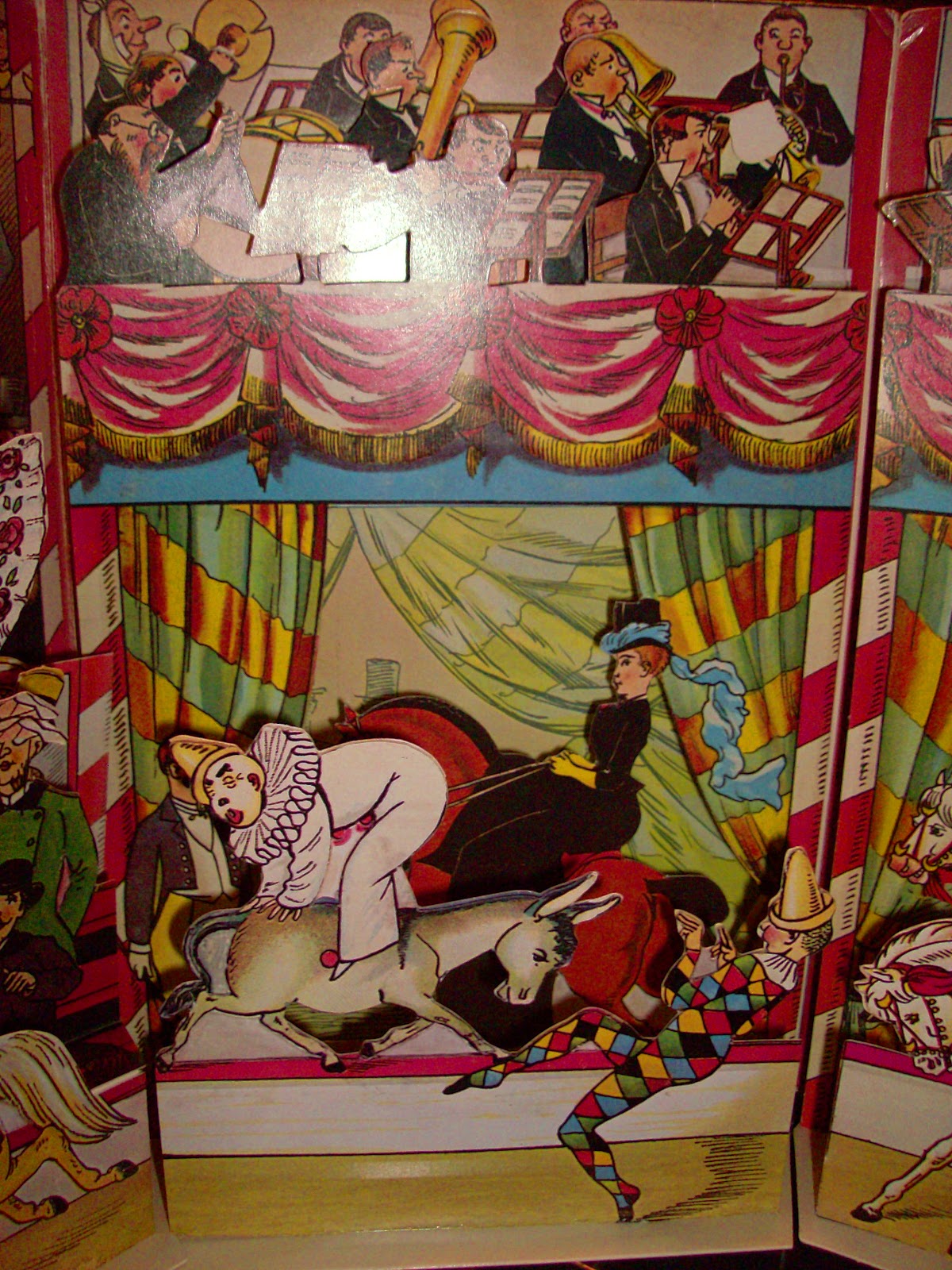
Pop-up: Circus

The shots below (pardon the flash reflections on some shots - the lighting conditions were less than ideal - are from a reproduction pop-up book published by Penguin Books in 1979. The book - Lothar Meggendorfer's "International Circus", first published in 1887 - also has the name of Rodney Peppe associated with it.


Thursday, December 01, 2011

Alice: 3D becomes 2D


I wrote about the Alice Theatre previously, when it was being offered in a 3-D format.

Now, the creator has made it available in good old fashioned 2-D.  You can print and use as a traditional theatre (which is amazing enough), but they also demonstrate how it can be inventively used with other images for photography prints!

Tuesday, November 29, 2011

Story Behind the Story


I wrote about this before...

The above clip is from a new documentary explaining who the artists were that created the huge, wall mural depicting a very LARGE toy theatre several stories high!  It's the story behind the story...

Tuesday, October 25, 2011

Another Toy Theatre Mural!


The Toy Theatre is a mural created by artist Peter Waddell on a wall at 1914 Sunderland Place NW at New Hampshire, a block south of Dupont Circle, in Washington, DC...

Monday, October 03, 2011

Anthropomorphic Taxidermy


I don't know about you, but I think anthropomorphic taxidermy has a great power to convey stories and ideas. I adore them...

Sunday, September 25, 2011

Theatre Centenary


Nigel Peevers shared this recently:
The Lyceum Theatre in Crewe was 100 years old this year and for their centenary they had a specially commissioned light show projected on the front of the building...in one of life's weird little coincidences I'd already been telephoned and asked if they could use some images from my toy theatre book in the show.

Monday, September 12, 2011

Toy Theatre Large-Scale Mural

"The Toy Theatre is a mural being created by artist 
Peter Waddell with the assistance of fellow artists..."
An amazing public space arts project is unfolding right now in the Washington, DC area. An artist is painting a large-scale mural on a side of a historical building, in a historical neighborhood.
Slowly appearing on the wall is a huge painting of a giant toy theatre. Beneath the monumental proscenium arch, 40' high, the stage is set with scenery representing the first two great mansions of Dupont Circle. The British Legation on Connecticut Avenue and “Stewarts Castle” on the Circle arose from the area's rough farmland in the 1870s.
To see the progress as it unfolds, visit the gallery page of the artist's website.