Showing posts with label books. Show all posts

Thursday, December 24, 2020

Simon Armitage Hansel and Gretel, Re-imagined

A "newish" book (published in 2019) from poet laureate Simon Armitage, in collaboration with artist Clive Hicks-Jenkins. 

Simon Armitage’s extended narrative poem uses the well-known framework of the Brothers Grimm tale but gives us a new contemporary interpretation and focus. This is a darker, glittering Hansel & Gretel fairy story for the 21st century, of refugees, bombed villages, homelessness, a landscape where nothing is quite as it seems, but of humanity, humour and hope too. 

The powerful story is illustrated by the visual creations of artist Clive Hicks-Jenkins. His compelling Hansel & Gretel characters have appeared as prints, and as a Toy Theatre for Benjamin Pollock's Toyshop and re-imagined here using the imagery of the toy box of mid-century wooden puppets, villages and building blocks in creating a unique, contemporary fairytale landscape.

Saturday, July 11, 2020

Brian Zelznick Does Doll Face as Toy Theatre!


Our newest virtual offering is a charming, zany, 10-minute toy theater show directed by Brian Selznick, writer and illustrator of “The Invention of Hugo Cabaret” and “The Houdini Box,” and the illustrator of the 20th anniversary “Harry Potter” box set. The show is based on the 1994 children’s picture book written by Pam Conrad and illustrated by Selznick.

At the time, the book was a sweet story about a doll who throws herself a party with her friend’s knife, fork, spoon, and plate. 

“Twenty-five years later,” says Selznick, “my friend Jacqui Russell asked me if I would help to turn ‘Doll Face Has a Party!’ into a puppet show.

She thought that children might especially enjoy it during this time of quarantine because Doll Face never leaves her home, throws a party because she is bored and makes friends with the items around her house.

Creative Team:
Directed by Brian Selznick
Based on the Book, "Doll Face Has a Party!"
Text by Pam Conrad / Pictures by Brian Selznick
Produced by Jacqueline Russell
Designed, Built, and Puppeteered by Will Bishop & Grace Needlman
Narrated by James Lecesne
Music by Tuba Skinny
Additional Music by Robin Rapuzzi
Sound Design by Kevin O’Donnell

Sunday, April 01, 2018

Maker Spotlight: Maggie Rudy & Mouseland


Recently, I discovered a wonderful article about  Maker Maggie Rudy, who invited us into her studio where all the magic happens for Mouseland...


Artist & Author, Maggie Rudy

Maggie’s fascination with mice began in the third grade, when her family moved to Lancaster, England, where her father, a biologist, had a two-year postdoctoral fellowship in physiology. She awoke from her “baby stupor” to an English aesthetic that would remain hugely influential in her life: hedgerows, gypsy carts, and a field trip to the home of Beatrix Potter. From a shop in Lancaster, the Rudy household acquired some mice made of felt. She and sisters Susy and Annie dressed them and placed them in a variety of settings. The “rapture of the tiny” that she celebrated in childhood has never left her.
- Rapture of the Tiny

The short film below is fun to watch, where Maggie lets us in to her studio, and shows us a few of her secrets on how she makes the magic happen!


Currently, Maggie has a traveling diorama touring the US, as shown below. Be sure and check it out if you can, when it comes near you!

Friday, December 22, 2017

The Chelm Legend: Fool Moon

A theatrical adaptation based on the humorous stories of Chelem and Eastern European Jewish folklore. Leimech and Laizer set out on an adventure to find a new moon for the town of Chelem to replace the one that was stolen.

The plot unfolds via a pop-up book, combined with puppets and shadows and incorporating original klezmer...


Reviews:
Galia Levy Grad has created a world of magic and beauty using the simplest, most minimalist techniques: the entire drama materializes out of a pop-up picture book. The visibility of the theatrical mechanism to the audience only serves to enhance the magic and liveliness of the two-dimensional figures. Galia has created exhilarating theatrical moments by means of inventive, aesthetic and highly imaginative elements. 
 - Comments by Judges’ Panel, 22nd Haifa International Children's Theatre Festival, 2012

A brilliant adaptation of the Chelm stories for paper theater, created jointly by Naomi Yoeli and Galia Levy Grad. (The latter is also the narrator and manipulates the characters, engaging in lively dialogue with them.) It’s impossible not to fall in love with Levy Grad, who brings to life the townspeople made of beautifully decorated papercuts; they appear, in fact, from an old book of tales, like pop-up postcards. The show reminds us of the true magic of theater and is an extraordinary glimpse at some wonderful stories from Jewish culture.
- Merav Yudilovitch, Ynet

Tuesday, September 19, 2017

Maker Spotlight: Studio Schaapman & Mouse Mansion!


Studio Schaapman is a family business, consisting of Karina Schaapman and her children, Tom, Ian, Manita, and Lili. They are the creators of the children’s book seriesMouse Mansion (translated into 25 languages).


In the books, they use detailed miniature settings they build themselves that can now be admired at their Amsterdam Muizenhuis (or Mousehouse) shop. At the back of the shop is their studio where they create their mouse worlds, and where visitors can look inside. People often ask questions about the inspiration, design, and construction of the mouse mansions.


In the Mouse Mansion shop & studio you can:
  • Marvel at the Mouse Mansion sets built for the books, including the harbor, funfair, circus, and theatre
  • See how they are built and ask the makers questions
  • Listen to audio books and read all the Mouse Mansion books
  • Browse around the shop for Mouse Mansion goodies
  • Children can color while parents can take a seat to read to their child


Studio Schaapman even provides video tutorials for those who want to build their own mouse houses!

Saturday, June 18, 2016

Tunnel Book: Zombifying a Classic

When watching a recent film entitled, Pride + Prejudice + Zombies, I was enchanted by its opening prologue...


In keeping with Regency-era authenticity, the prologue unfolds through a tunnel book, providing a theatrical stage for the fictional narrative to take place. Working with satirical newspaper cartoonist Martin Rowson, Ben and team transformed hand drawn illustrations into 3D animations, intricately rendered and paced to the prologue’s voice over narration...Pride + Prejudice + Zombies was all done in 3D, the team worked hard to recreate the visceral and dusty reality of a regency tunnel book, they added creases, paper texture, flickering candle light, jerky animation, lens distortion and depth. - The Mill
A wonderful article about the "world-building mashup".

Monday, May 28, 2012

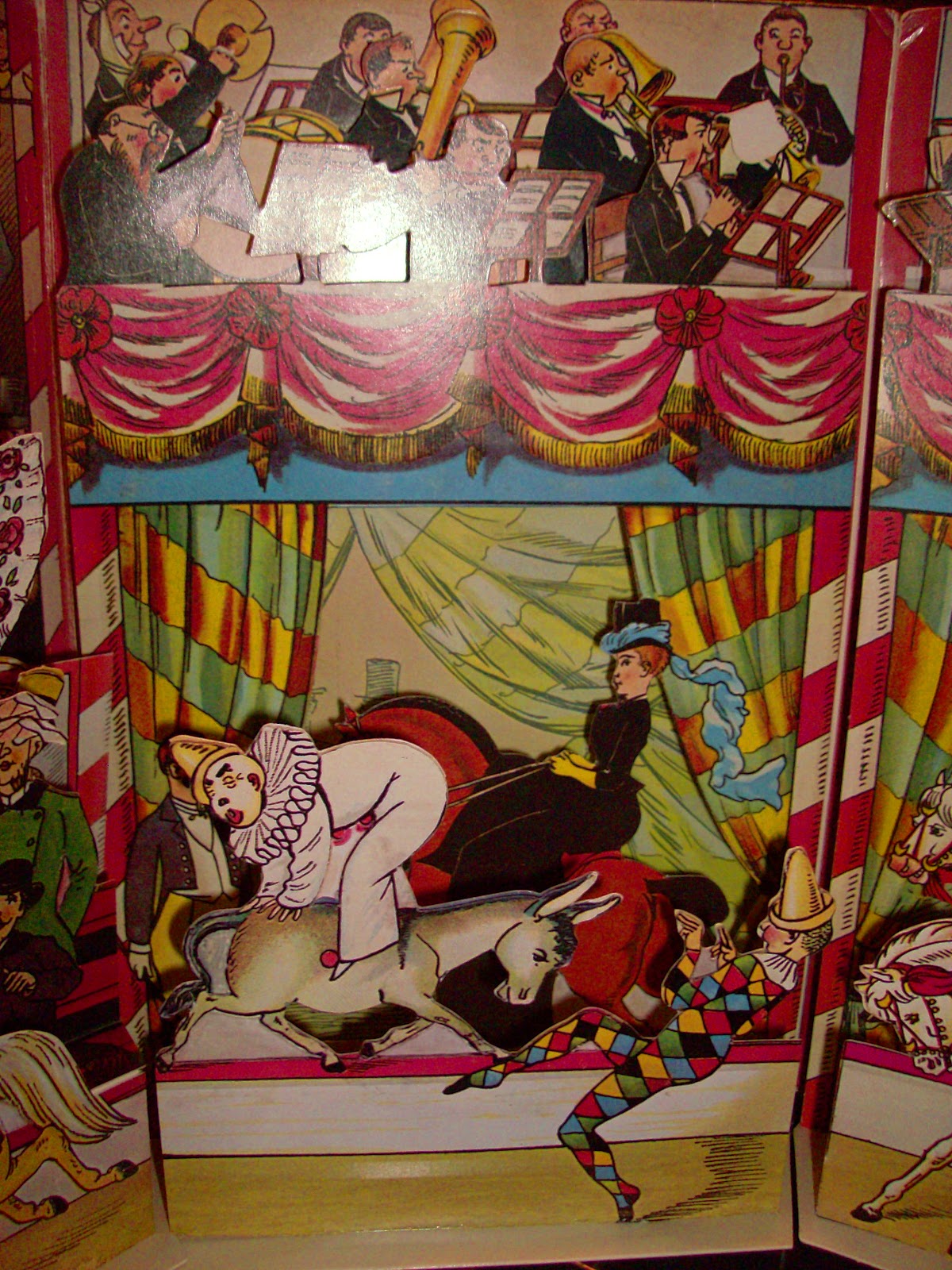
Pop-up: Circus

The shots below (pardon the flash reflections on some shots - the lighting conditions were less than ideal - are from a reproduction pop-up book published by Penguin Books in 1979. The book - Lothar Meggendorfer's "International Circus", first published in 1887 - also has the name of Rodney Peppe associated with it.


Thursday, December 01, 2011

Alice: 3D becomes 2D


I wrote about the Alice Theatre previously, when it was being offered in a 3-D format.

Now, the creator has made it available in good old fashioned 2-D.  You can print and use as a traditional theatre (which is amazing enough), but they also demonstrate how it can be inventively used with other images for photography prints!

Sunday, September 25, 2011

Theatre Centenary


Nigel Peevers shared this recently:
The Lyceum Theatre in Crewe was 100 years old this year and for their centenary they had a specially commissioned light show projected on the front of the building...in one of life's weird little coincidences I'd already been telephoned and asked if they could use some images from my toy theatre book in the show.

Tuesday, April 26, 2011

Puppetry International Issue #29: TOY THEATRE!

Several weeks ago, I was asked if I would be interested in submitting an article for the next issue of Puppetry International, which was going to focus an entire issue on toy theatre. I happily agreed, and submitted a book review about Mo Heard's new book, Leo's Heroes.

Well, the issue has just been published, and I got a copy in the mail today.  I am tickled pink with the result.

The entire issue highlights the wonderful world of toy theatre, including of course some of its history, but just as importantly, the current renaissance of the form in many wonderful ways.

Saturday, March 05, 2011

Toy Theatre at the Library

Decameron no 2 by John Elmslie
Decameron no 2 a photo by John Elmslie on Flickr.


Mariella Bertelli is a storyteller and librarian with an extensive background in puppetry and theatre. She has recently worked on a retelling of the 16th century Italian classic Orlando Furioso and on her own stories inspired by material in the Toronto Archives.


Decameron no 5 by John Elmslie
Decameron no 5 a photo by John Elmslie on Flickr.

I contacted Mariella to ask about her involvement in toy theatre.  She shared that "...toy theatres are my passion after discovering them while working at the Osborne collection of Early Children's books...With my friend (and fellow librarian) Mary Anne Cree we have developed and performed (to private audiences) two shows -real adult content- adapting two stories from Boccacio's Decameron, and have had lots of fun doing them."


The source material sounds very challenging to adapt, but from the still shots I found of her doing one of the productions, shared here, it looks like it was an amazing occasion, complete with live music according to the notes!

Saturday, December 11, 2010

Memoirs of a Muse

The Muse discovers her powerful relationship with mankind...
I received a wonderful surprise in the mail the other day.  I opened our rural delivery mailbox to find a fat envelope addressed to me.  I looked at the return address and was delighted to see it was from my old friend Gail.  I thought to myself, "Hmmm, I wonder what Gail has sent me?!"  I was excited to find out...


The contents of the envelope turned out to be two volumes of a planned trilogy, a 'graphic novel' of sorts entitled "Memoirs of a Muse".  I sat down later and devoured them both, then of course started to wonder where the inspiration for the books (ironically about that very subject of inspiration, aka the 'Muse') came from.  I went to the source...

Gail shared that "...I was reading a book called The Story of Painting, where the author connected each artist to the next and I thougtht it's like the muse is a groupie that goes from one star to the next. Then I was walking around at work and thought what would be the beginning of the muse's story?"

The first volume follows the beginnings of the Muse's relationship with mankind through several characters including Enoch and Moombi.

In the second volume, the Muse meets up with General Lakhdunlim, King of Mari, and thus later his bride - Ariadne, a "Minoan princess from the Knossos palace on the Island of Crete." Theirs was an unhappy marriage, but lucky for her, she had an opportunity to start a new life.  It came with a price, out of which she created a memorial in a form of a statue.  In turn, the statue came to represent a legend of the real woman it was once inspired by, and thus a cult was born.  Eventually the Muse moved on to a young potter Nashuja.

Nashuja and the Muse end up on a journey to Egypt, and we are left with a cliffhanger - the Muse thinks she might be able to get back in touch with her first artist, Enoch, because she has heard the Egyptians had special knowledge of the afterlife.  But that will be another story, in Volume III.  I look forward to it!

Monday, November 08, 2010

New Toy Shop Opens!

Peter Baldwin shares his passion for toy theatre [Photo Credit:  BBC]
Benjamin Pollock's Toyshop has opened a new branch.

You read right.  The well-known toy shop, particularly known for toy theatres, is branching out.

Read more about it here...

Wednesday, September 15, 2010

Book Review: Leo's Heroes


I want to tell you about a book I recently read entitled "Leo's Heroes". I wrote a bit about it a few weeks ago when the author was kind enough to send me an advance copy of the book for the very purpose of reading and reviewing it. As many times happens, life got in the way and I was delayed. Thanks to a kind reminder by Mo, I got down to business this past weekend and dived into the world of Leo.

What struck me was how vibrant and alive his world is. His mother (or Mum) has a wonderful sense of humour, and both his parents show an intelligent and patient style of relating to him. His excitement of obtaining and collecting more toy theatre sheets reminded me of the excitement I've seen on many occasions of kids nowadays in comic book shops excitedly asking about this week's latest Magic-the-Gathering cards. There are words in the story that might not be familiar to American readers, but are fun to discover and learn, such as stookie, boffin, mudlarks, 'Billys & Charleys', chink, stum.

Aspects of the book are reminiscent of the the Young Indiana Jones Chronicles, because it incorporates well-known (and some not so well-known, but fascinating) real people and real events from history - Benjamin Pollock, John Logie Baird, Frederick James Camm(and his brother Syd), to mention just some. The vernacular spoken by these characters bring the story alive and will immerse the reader, helping them lose themselves in the story - and that's what a good story SHOULD do!

One of "Leo's heroes" is Dr. Who, and ironically Leo himself ends up eing a kind of Time Lord, participating in key ways in various people's lives and events in the past.  The ultimate answer as to how and why Leo can time travel is eventually revealed...but you'll have to read "Leo's Heroes" to find out!

"Leo's Heroes" book launch is scheduled for September 26th.  You can find out more details at the author's website...

Friday, August 13, 2010

Book: Leo's Heroes


Time travel story involving toy theatre!
Then he did a strange thing. Leo saw him take a small twist of paper from his waistcoat pocket, unfold it, and scrutinise the contents. ‘Have you seen this before Leo?’ He held out the scrap of paper. There, glowing brightly, was a tiny sliver of blue rock.

Leo peered into the paper. ‘No, never seen anything that colour.’

Mr Pollock shook his head. ‘I got this last night from a friend of mine. He was telling me some strange nonsense about … ‘ The man put his hand on Leo’s shoulder. ‘I was wondering if you might be linked to it … you seem … so different to my usual boys. As though you don’t belong here.’

Leo put his finger to touch the blue rock, and as he did so, Benjamin Pollock shimmered before him in the growing darkness, his voice echoing ‘Don’t, don’t’, while Leo’s insides somersaulted, and he was tossed through a hot whirlwind to land on his duvet in his room, staring up at the red Chinese paper lampshade which was twisting crazily above his bed.

- From Leo's Heroes, by Mo Heard
As many readers know, there is an amazing shop in London called Pollock's Toy Shop, run by Peter Baldwin, ably assisted by Louise Heard.

Louise's mum, Mo Heard, has recently contacted me about a wonderful new book she has written. Toy Theatre is featured prominently in the book in a most creative manner, involving time travel. Shades of Doctor Who, anyone? I like what I've seen and heard so far!

Let me share a bit of what Mo has told me:
I'd like to tell you about my new children's book, Leo's Heroes, which features a time-traveling boy who meets real people from the past. In the first chapter he's whizzed to Benjamin Pollock's shop, and then later Mr. P gives him a show.

The whole story will gradually unfold on my children's blog (the outline of the Pollock story is up there already), and my own blog describes how I had the idea for the book.

There were two Victorian men - mudlarks - who duped the antiques world with their fakes of medieval medallions, (they were called 'Billys and Charleys') and I have Leo actually giving them the idea when he's zoomed back to the poverty-stricken East End!
The framework of how Mo is telling Leo's tales reminds me of the television series several years ago called The Young Indiana Jones Chronicles.  In that series, director Steven Spielberg - using his famous film character Indiana as a little boy and young man - told stories of famous events and featuring famous people from history. I adored that series and the premise it used - pure genius I thought.

I think Mo is onto something using the same premise in her new book, and I'm delighted it features toy theatre in that premise. It’s a fun and creative way to get kids involved and excited (and learn) about history. As an avid local historian, and history fan in general, I’m all for it!

Enhanced by Zemanta

Friday, August 08, 2008

A Pook Put Out


From soon-to-be-published The Adventure of the Queen’s Dolls’ House, by Kenneth N. Kurtz...

Let us return to the week previous and see a Pook most proud, for he had found not only the dolls’ house in Mary’s nursery, but three others as well. Two were rather shabby one-story affairs in more distant communities called Croydon and Sidcup, but the third, in ever-so-fashionable St. John’s Wood, was quite grand, marred only by the fact that its human owners were twins, and of the unfortunately rambunctious age of eight. Over the past years Pook had done exceedingly well by his tribe, finding many such miniature domiciles. Perhaps too well, for neither King Obera or Queen Tania demonstrated much enthusiasm when Pook informed them of his latest discoveries. None-the-less, these new housing opportunities would be publicly announced on the very next Monday.

And why Monday? Because of the performance of the Teasers and Tormentors at Pollock’s Toy Theatre Shop in Hoxton Street. Here was one occasion when all of London fairydom would be brought together, and therefore the perfect venue for any proclamations of a civic nature.

You might think that the Teasers and Tormenters had taken their names from the famous masks of comedy and tragedy. After all, one mask did seem to tease with its smile and the other certainly howled in torment. But in fact the fairy troupe had stolen its name from those given by humans to a theatre’s curtains. Teasers stretched across the top of a stage and tormenters hung down at the sides.

Pollock’s sold all kinds of toy stages made out of brightly printed papers. There were grand opera houses, famous West End play houses like the Drury Lane, and even tiny provincial theatres. Each of them was furnished with cardboard wings and back scenes for a particular play or musical extravaganza. Some were set up for plays by Shakespeare, some for operettas by Messers Gilbert and Sullivan or for operas done at Covent Garden, but most displayed scenery from Christmas pantomimes, especially Cinderella and Aladdin. And of course one was outfitted for a production of Peter Pan.

It was quite easy for giant humans to slide in new wings or take out paper back cloths for changes of scene in the tiny toy theatres, but fairies, being as I’ve said the epitome of laziness, would have none of that. So each Monday of “The Season”, the Teasers and Tormenters flew early to Pollock’s, often arriving at the very moment after the proprietor had locked up the shop. This was so that they might take a quick fly-by along the many display shelves and decide which theatres had the correct scenery for tonight’s performance. You see, when audience as well as actors can fly, well then why change scenery at all if you can just as easily change theatres?

Laziness also played a part in performance. No fairy actor would ever think of reading, let alone the hard work of learning lines. Improvisation was everything. But then, if you had spent nearly every evening watching a performance at The Old Vic or the Royal Opera House, well then it was quite easy to copy what you’d heard and call it improvisation.

(In fact, next time that you go to the opera, look very closely at the many candelabra that line the balcony fronts. Then count the actual electric candles on a particular bracket. You may see that there are one or two more sparkles than candles. If so, then quite possibly a fairy perches there, and is enjoying a view from one of the best seats in the house. At the Old Vic fairies usually hide among the chandeliers.)

Besides watching the show, they are waiting for the “big moment” when all of the human performers are onstage. These are excellent times to work one’s way back to empty dressing rooms and thereby enjoy feasts of flower nectar garnered from big bouquets labeled “Break a Leg”, or boxes of sweets left out on make-up tables. It is for this reason that fairies are unlikely to know the music from the triumphal march of Aida or speeches from the ball room scene from Mr. Shakespeare’s Romeo and Juliet. They have all been off on their own special interval swigging nectar or gobbling sweets.

The leader of the Teasers and Tormentors had, because he thought it quite posh, taken the name Horatio. On this particular Monday night the leader and his chief henchmen hovered outside the shop and clustered about a street lantern. They watched Mr. Pollock lock the door for the evening and wearily walk off down Hoxton Street, then they used moonbeams to slide through the display window. Horatio had decided that tonight’s performance would be about the life of a very great fairy king. Aha! That model of the Old Vic, the one with the forest scene, would be perfect for the opening scene. Horatio and his associates flew along the shelves and chose a castle throne room, a shepherd’s rustic hut, a mystic cave, and a festive banquet hall as their other scenes. By then all the rest of the troop had arrived. They huddled to decide the details of the plot. Do you see what I mean by “improvised”?

A half an hour later, small shimmerings materialized all over London. They coalesced into rivers of glimmerings converging on Hoxton Street. Horatio and his chief associates, Toby and Belch, waited at the shop window to greet their audience. An hour later, once all had arrived, Horatio, Belch and Toby, along with several others tugged with all of their might to close the huge window curtains. Well, it wouldn’t do for late night human passers by to notice strange lighting effects in Pollocks. Then they led the audience to the first theatre.

Hundreds of fairies soon hovered in what seemed to be a half bowl, or rather a neat vertical pile of horseshoes, facing the paper proscenium. In the very center of the lowest horseshoe, directly opposite the stage, were Queen Tania and King Obera. Fairy princes and princesses hovered on either side. The next ring above was made up of important court officials such as Frigo and Motha. And at the very top, five rows up, in that ring known in the human theatre as “The Gods”, flew the poorest and least significant of fairies. Well, of course, for this was the way that the Royal Opera House was set up.

The five flying horseshoes rang and shimmered with excitement. Next, Horatio, using a large hat pin, flew down to the center of the stage and thudded his ‘staff’ for attention. Ringing stopped and shimmering subsided, very like the dimming of the house lights in human theatres. All watched the stage.

Horatio swaggered upstage with his hair pin. Then Belch popped up through a trap door in the cardboard floor. He held a tiny paper shovel and mimed digging a grave. Horatio crossed down to the edge of the hole. Belch held up an acorn on which had been painted a ghostly white face.

“Oh woe, a skull. Whose is’t?” declaimed Horatio.

Belch answered: “Alas, poor Yore, I knew him, Horatio.”

Thus began a presentation of the remarkable life and great adventures of the most famous of fairy kings. This included his unfortunate demise when, after a great human banquet had ended, and all the guests had dispersed to the ballroom, Yore flew down from the chandelier to partake of a succulent bit of uneaten trifle, gorged himself to a fatness almost too much to allow flying, and was surprised when the servants came in to clear away. Yore hurriedly flew up into the flickering camouflage of one of the candelabra. Here alas, while flying too close to the flame, he was unfortunately snuffed out by an immense serving maid.

The hovering horseshoes wept and shimmered deepest blue at the play’s tragic end. Then as all of the Teasers and Tormentors flew onstage for a company bow, the audience erupted in glorious shimmers of bright pinks and golds and greens, and a veritable clarion of ringing applause.

At the end of this colourful and noisy ovation, King Obera flew to the stage and beckoned up to the second highest horseshoe for Pook to fly down and join him.

“You all know our chief scout, Pook,” said the King, “Well once again he has found some dolls’ houses, four of them in fact, and if any of you are looking for new digs, then he’s the one to see.”

Pook stood proudly with his St. Athelstan breast plate shining and sank into his deepest and most theatrical bow, but there was only a smattering of applause. Indeed, no one bothered to see him after the performance, or during the next few days. That is why he was now “a Pook put out.” Very put out. Obviously his hard work had led to a real-estate market that had become a tad over-saturated.

“Well,” thought Pook, five nights later, as he flew away from the king’s house in Belgravia, “If no one appreciates my work, then I will take some time off. In fact I shall hide away and nap for several days. Maybe several weeks, or even months. Make them worry and wonder for a bit. I’ll show them.” And he knew where too. The house no one seemed to want on Mansfield Street would be perfect. He could sulk in peace.

Pook shimmered through the glass of Mary’s nursery window. But froze just inside, for the distinct odor of grumpy old lady hovered around the wing chair. Fairies possess superb noses. But all was safe, for the chair was empty. And Mary slept quite soundly in her bed on the far side of the room. Pook alighted from his moonbeam at the open front door of the dolls’ house and went through and up the stairs to the larger of its two bedrooms. He had taken off his sash and breastplate and hung them on a chair, and was just about to jump in and snuggle under the coverlet, when a lovely new odor tickled his nose. Chocolate!

He sniffed more deeply. It was faint, but obviously a very good chocolate. Pook certainly knew how to choose his houses. He hurried below to the dolls’ house door and took a deeper whiff. Hmmm…Cherries and creams too. Shimmering, but certainly not ringing, Pook flew out of the nursery, along the corridor and down the staircase.

(There’s more to this chapter, for Pook discovers that the greatest Doll’s House of all time is being assembled in Mary Lutyen’s drawing room, but that has naught to do with Pollocks.)

Wednesday, July 16, 2008

Toy Theatre Collection Published

From toy theatre collector Nigel Peever comes this news about his exciting new book...
My book has just arrived in the post, all the way from America. I'm really pleased with it, nearly 420 toy theatre sheets all in one neat book.

You can find it here.

It's a massive bespoke book, produced individually for each purchaser so it's not cheap but I hope you'll agree that by putting so many sheets in one book it certainly works out a lot cheaper than making a book up for each play for example. And probably cheaper than printing the sheets off on your own home printer.

It's good quality paper too, Hi res scans, a very professional book just like any you'd find in a bookstore.

You can preview the first few pages by clicking the book preview bit on the url I've given you...